1. Me presento
4. Mi edad
En español, usamos el verbo TENER para hablar de la edad (p.ej. "Tengo tres años"). Esta característica no es única del español; la encontramos en otras lenguas romance (p. ej. “J’ai trois ans”, en francés; “Ho tre anni”, en italiano; “Eu tenho três anos”, en portugués).
In Spanish, we use the verb TO HAVE to speak about age (e.g., "Tengo tres años"). This characteristic is not unique to Spanish; we find it in other Romance languages (e.g., "J’ai trois ans" in French; "Ho tre anni" in Italian; "Eu tenho três anos" in Portuguese).
El verbo TENER
The verb TO HAVE
|
Español
|
English
|
|---|---|
|
¿Cuántos años tienes (tú)?
|
How old are you? (informal)
|
|
¿Cuántos años tiene (usted)?
|
How old are you? (formal)
|
|
¿Qué edad tienes / tiene?
|
What is your age? (informal/formal)
|
|
Tengo 18 años.
|
I am 18 years old.
|
“Tengo 18 años” significa que tengo 18 años de vida o de experiencia en este mundo. No usamos el verbo “SER” porque este verbo se utiliza para hablar de características esenciales con las que nos identificamos. No podemos identificarnos con un número; sin embargo, sí que podemos identificarnos con un grupo de edad. Así pues, podemos decir “soy un/a niño/a”, “soy un/a adolescente”, “soy un/a adulto/a”, “soy joven”, “soy mayor”, “soy viejo/a”...
"Tengo 18 años" means that I have 18 years of life or experience in this world. We don't use the verb "SER" (TO BE) because this verb is used to talk about essential characteristics with which we identify. We cannot identify ourselves with a number; however, we can identify with an age group. Therefore, we can say "I am a child," "I am a teenager," "I am an adult," "I am young," "I am elderly," "I am old"...
¡Cuidado! Debes pronunciar bien la ñ; no es lo mismo decir “tengo tres años” que “tengo tres anos”.
Be careful! You must pronounce the "ñ" correctly; it's not the same to say “Tengo tres años” ("I am three years old") as it is to say “Tengo tres anos” ("I have three anuses.").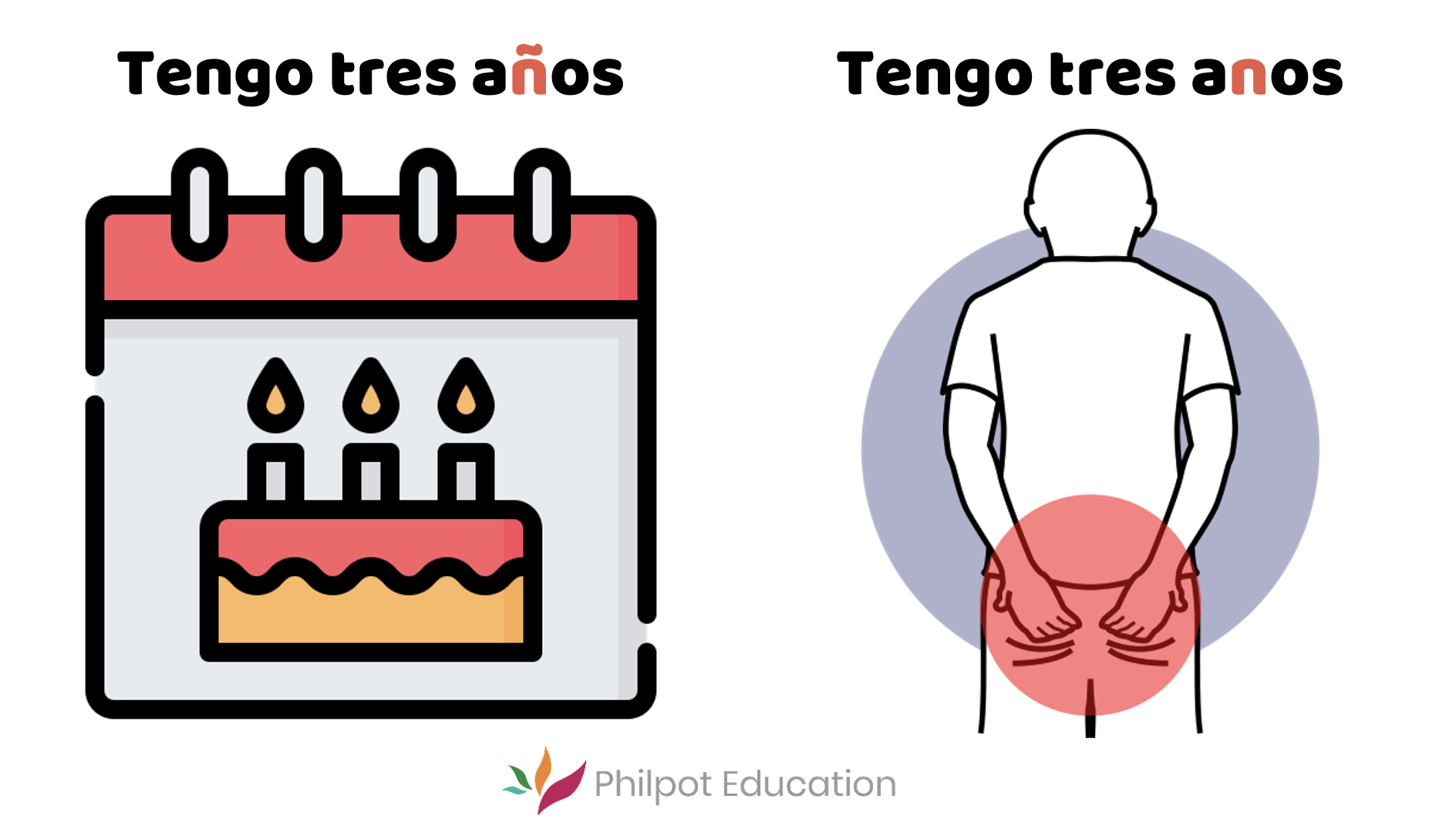
Enlace cultural: La letra eñe
Cultural link: The letter eñe
¿Sabías que la letra Ñ es la única letra del alfabeto español que tiene su origen en España? La letra Ñ (eñe), tan emblemática del idioma español, tiene su origen en la Edad Media. Representa un sonido nasal palatal que en otros idiomas se representa con dos letras: GN (francés, italiano), NH (portugués) o NY (catalán). En el antiguo castellano, el sonido se representaba primero con las letras NN. Los escribas, para ahorrar papel, tiempo y esfuerzo, crearon una abreviatura para este sonido como una sola N con una pequeña virgulilla encima. En 1492, la letra Ñ hizo su primera aparición oficial en la Gramática Castellana de Antonio Nebrija.
Did you know that the letter Ñ is the only letter in the Spanish alphabet that originated in Spain? The letter Ñ (eñe), so emblematic of the Spanish language, has its origin in the Middle Ages. It represents a nasal palatal sound that in other languages is represented with two letters: GN (French, Italian), NH (Portuguese), or NY (Catalan). In old Castilian, the sound was first represented with the letters NN. The scribes, to save paper, time, and effort, created an abbreviation for this sound as a single N topped with a little squiggle. In 1492, the letter Ñ made its first official appearance in the first Spanish Grammar, by Antonio Nebrija.
Para conocer el resto de letras del alfabeto, haz clic aquí./To learn about the other letters of the alphabet, click here.