1. Mi vida cotidiana
2. ¡Buenos días!
En esta lección vamos a hablar de nuestra rutina matinal (o matutina), es decir, de las acciones que conforman nuestra mañana, desde que nos despertamos hasta la hora de comer. Empecemos con una actividad interactiva.
In this lesson, we will talk about our morning routine, that is, the actions that make up our morning, from the moment we wake up until lunchtime. Let's start with an interactive activity.
Antes de desayunar (before breakfast):
Después de desayunar (after breakfast):
Verbos reflexivos
Reflexive verbs
In the morning, we perform many personal hygiene actions. To talk about these and other actions, we use reflexive verbs. They are called reflexive because the action of the verb falls on the subject who performs it. For example, when I say "I shower," I am the subject performing the action of showering, but I am also the object of the verb, that is, the person receiving the shower. Here is a list of reflexive verbs related to the morning routine.
| Despertarse = to wake up (oneself)
|
Me despierto = I wake up (myself)
|
| Levantarse = to get up (oneself)
|
Me levanto = I get up (myself)
|
|
Lavarse = to wash (oneself)
|
Me lavo = I wash (myself)
|
| Ducharse = to shower (oneself)
|
Me ducho = I shower (myself)
|
|
Bañarse = to bathe (oneself)
|
Me baño = I bathe (myself)
|
|
Cepillarse = to brush (oneself)
|
Me cepillo = I brush (myself)
|
|
Peinarse = to comb (oneself)
|
Me peino = I comb (myself)
|
| Maquillarse = to put on make-up (on oneself)
|
Me maquillo = I put make-up (on myself)
|
| Afeitarse = to shave (oneself)
|
Me afeito = I shave (myself)
|
| Asearse = to groom (oneself)
|
Me aseo = I groom (myself)
|
| Prepararse = to get (oneself) ready |
Me preparo = I get (myself) ready
|
|
Vestirse = to dress (oneself)
|
Me visto = I dress (myself)
|
|
Ponerse ropa = to put on clothes (on oneself)
|
Me pongo ropa = I put on clothes (on myself)
|
Observa y reflexiona: ¿por qué son incorrectas las frases de la columna de la derecha? / Observe and reflect: Why are the sentences in the right column incorrect?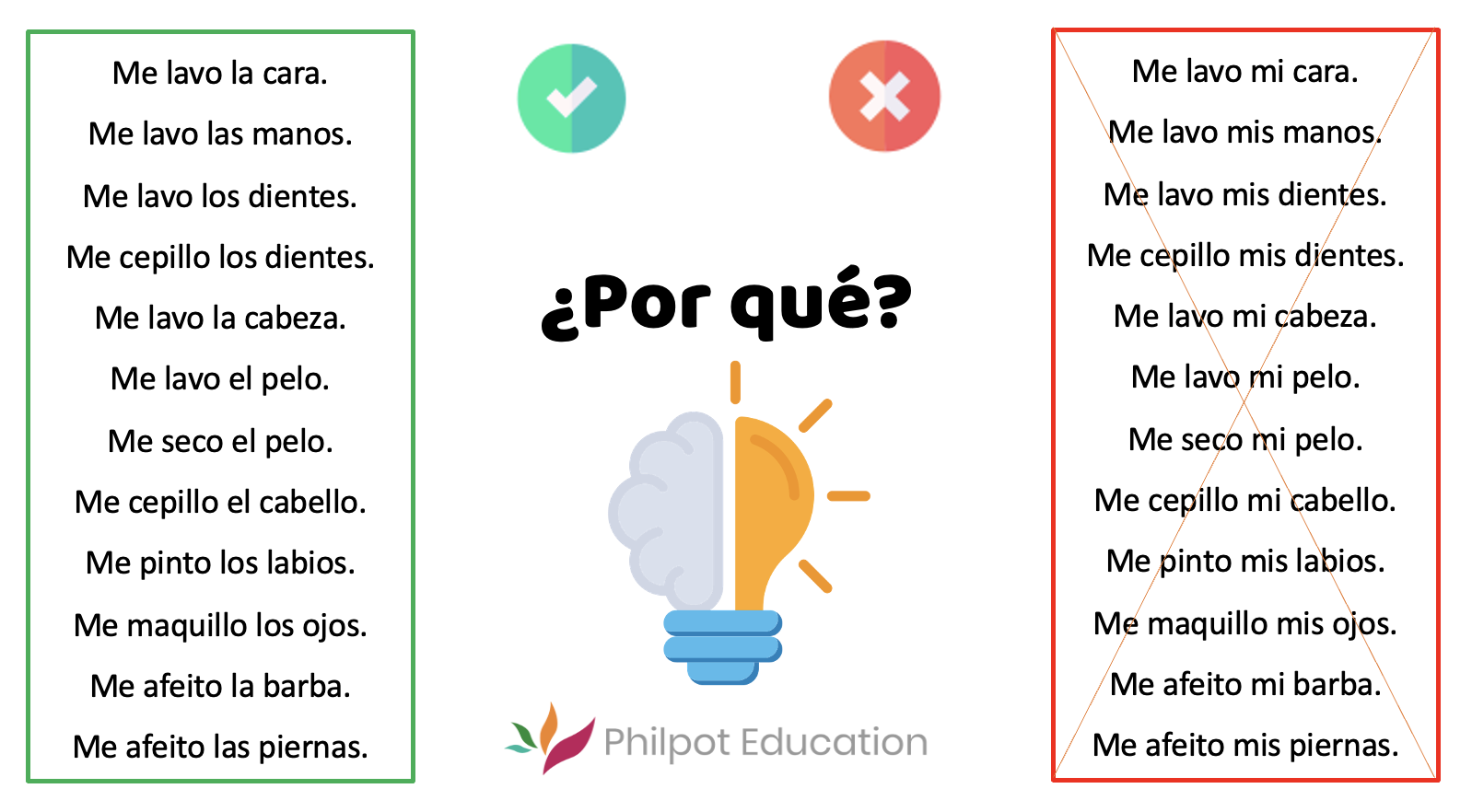
The phrase "me lavo mi cara" is redundant. We already know that it is my face that I wash, not someone else's, because the reflexive verb "me lavo" indicates that the action is performed on myself. Therefore, the correct form is: "me lavo la cara."
Cuando hablamos de nuestras acciones habituales, utilizamos el presente. Recuerda que también podemos usar el verbo soler + infinitivo, que ya vimos en la lección sobre hábitos alimentarios (Identidades, la comida y bebida). Fíjate en los pronombres reflexivos al utilizar esta estructura.
When we talk about our habitual actions, we use the present tense. Remember that we can also use the verb soler + infinitive, which we already covered in the lesson on eating habits (Identities, food and drink). Pay attention to the reflexive pronouns when using this structure.
Pronombres reflexivos
Reflexive pronouns
Pay attention to the reflexive pronouns when conjugating reflexive verbs in the present tense and when using them in an infinitive structure. Then, download the worksheet to practice.
| Normalmente, me despierto Normally, I wake up |
Suelo despertarme Me suelo despertar |
| Generalmente, te levantas Generally, you get up |
Sueles levantarte Te sueles levantar |
|
Habitualmente, ella se lava
Habitually, she gets up |
Suele lavarse Se suele lavar |
| Usualmente, nos duchamos Usually, we shower |
Solemos ducharnos
Nos solemos duchar
|
|
De costumbre, os bañáis
Usually, you bathe |
Soléis bañaros
Os soléis bañar
|
|
Por lo general, ellos se afeitan
Usually, they shave |
Suelen afeitarse
Se suelen afeitar
|