Tipos de texto (Text types)
Note from the author: Most of the content in this section has been written in English to help students grasp concepts quickly. Subsections intended for teachers are presented in Spanish.
2. Artículo
An article (un artículo) is a written piece of content that provides information, analysis, or commentary on a particular topic. It is typically designed to inform, persuade, or entertain its audience.
Articles can be found in various media, such as newspapers, magazines, school publications or online news platforms.
Model text and key features
Text adapted from https://www.periodismo.com/2025/05/15/una-obra-invisible-vendida-por-18-000-dolares-desafia-los-limites-del-arte/
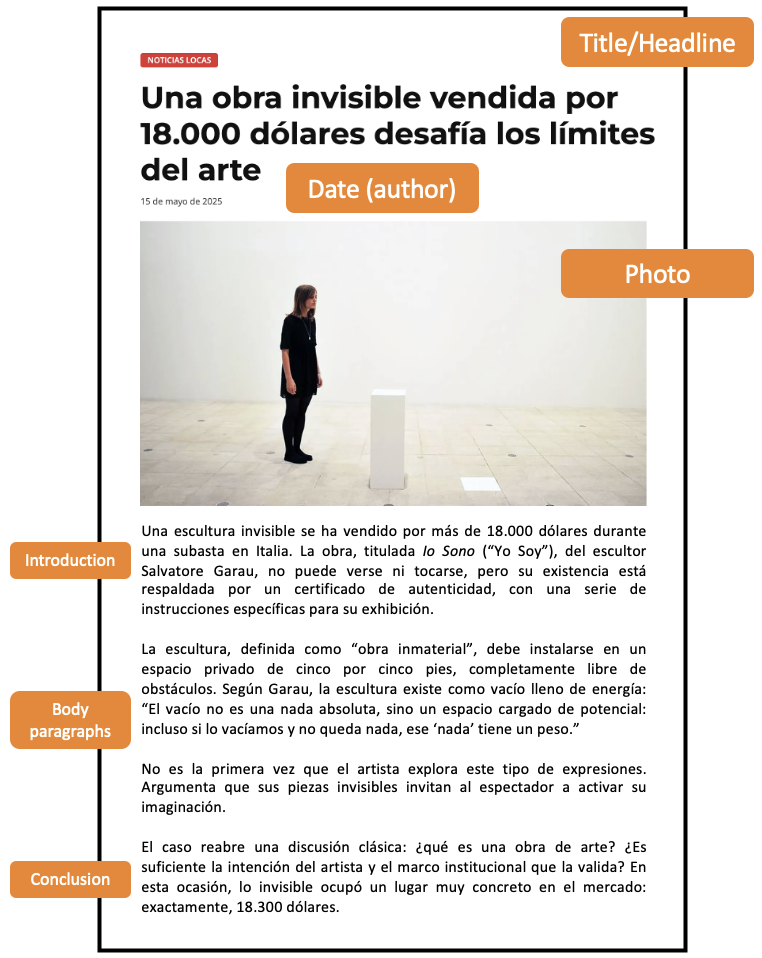
| Context | Audience | Purpose |
|
|
|
Key words
The following key words in the exam may suggest that the appropriate text type is an article (artículo).
|
Español
|
Inglés
|
|---|---|
|
La revista
|
The magazine
|
|
El periódico
|
The newspaper
|
| El diario |
The daily newspaper
|
|
El hebdomadario
|
The weekly newspaper
|
|
La gaceta
|
The gazette |
| El boletín informativo | The newsletter |
| La noticia | The news |
| Informar | To inform |
| Compartir | To share |
| Contar | To tell |
| Narrar | To narrate |
| Persuadir | To persuade |
| Convencer | To convince |
| Concienciar | To raise awareness |
Key points at a glance
|
Format
|
Message
|
Language
|
|---|---|---|
|
|
|
Key features, tips and examples
- Must be relevant.
- Make it catchy, but avoid exclamation marks.
- Make it stand out: write bigger and bolder.
Examples:
- La tecnología en las aulas: un arma de doble filo
- Cinco maneras de perder peso sin morir en el intento
- Luz verde a las energías renovables
- A good image catches the reader's attention more than words.
- Don't waste valuable exam time by drawing a picture; just draw a box and write the word 'FOTO' in it.
- If you have extra time, you may describe the content of the picture. How would you describe the picture in the model article? Try before reading my suggestions below.
Examples:
- Mujer admirando obra invisible
- Mujer contemplando pedestal vacío
- Mujer apreciando la nada
- The date is mandatory: It gives the reader context about the timeliness of the information being presented
- Credit to the author is optional, but recommended.
- Don't use your real name; create a cool Spanish pseudonym to preserve the anonymity of the evaluation process.
- There is no need to signpost the elements with key words such as 'fecha' or 'autor'.
Examples:
- 15 de mayo de 2025 - Carmen de la Cierva
- Por Miguel de la Torre - 7 de noviembre de 2025
- Must be relevant: it sets the direction of the article.
- Make it interesting: it is a hook to capture interest.
- May include a rhetorical question, surprising fact, or bold statement.
Examples:
- En plena era de la revolución tecnológica, la inteligencia artificial no ha tardado en llegar a las aulas. Sus aplicaciones son tan diversas como versátiles, pero ¿pueden dañar el proceso de aprendizaje de los estudiantes?
- Ya se acerca el buen tiempo, sinónimo de playa, chiringuitos, helados y tumbonas. Sin embargo, para muchos, las ganas de tomar el sol están reñidas con el pavor a probarse el bañador. ¿Cómo vamos a perder esos kilitos de más sin renunciar a los placeres del verano?
- Seguro que te habrás preguntado más de una vez cómo puedes ahorrar en la factura de la luz. La solución está en las energías renovables, que pueden hacer tu hogar totalmente autosostenible.
- Organize your ideas in clear sections or paragraphs.
- In addition to the structural scaffold (intro - body - conclusion), aim to build the body of your article by addressing each task in a separate paragraph. This will not only help the examiner correct your work, but it will also encourage you to identify the tasks and ensure you haven't missed any.
- Each paragraph develops one point, often supported with examples, facts, anecdotes, or statistics.
Remember:
- Missing a task will cost you three marks (Criterion B: Message).
- Not using paragraphs will cost you two marks (one in Criterion B: Message, and another one in Criterion C: Conceptual understanding).
- End with a bang!
- Summarize key points, offer a final thought or a call to action.
- May include a rhetorical question or a command (an opportunity to showcase your knowledge of the imperative mood).
Examples:
- Ahora que ya sabes cómo sacar provecho de las inteligencias artificiales, pregúntale a ChatGPT qué recomendaciones tiene para que puedas mejorar tu pensamiento crítico.
- Ya ves que perder peso sin morir en el intento no es tan duro como pensabas. Todo es cuestión de un poco de paciencia, perseverancia y previsión. Entonces, ¿a qué estás esperando para empezar tu 'operación bikini'?
- Las energías renovables no son la solución del futuro, sino del presente. Si aún no tienes paneles solares en casa, contacta hoy a tu proveedor de electricidad y solicita un presupuesto para tu hogar. No lo dejes para mañana: las energías verdes son renovables, pero las subvenciones se agotarán rápidamente...
Test your skills
Escribe entre 70 y 150 palabras.
Cada vez son más las parejas que deciden no casarse ni vivir juntas. Escribe un texto para una revista local destinada a un público joven, en el que expliques las causas de este fenómeno, sus pros y contras, y ofrezcas tu opinión personal.
| Artículo | Blog | Informe |
Reflect
- What would be the second and third best text types for this task?
- What would you have done differently if you were writing a blog instead of an article?
- What would you have done differently if you were writing a report instead of an article?
Click on the link to read a student sample for this prompt. Analyze it before reading the marking notes.
Download: Printable cheat sheet
Activities: Noticias Locas
- Collaborative and creative work: In groups, choose one of the headlines suggested by your teacher. Imagine the storyline and details behind the prompt, and together, come up with a new catchy title. Divide the work so that each of you writes one paragraph to build the body of your article using the 'hook-build-bang!' model.
- Peer feedback: Swap articles with another group to give and receive feedback.
- Reflection: Create a class exhibition by lining up the articles on a wall and reading the work from other groups. Reflect on what they did well and what they could have done better. Use post-its to leave comments.
- Individual work: Choose a different headline that caught your attention and write your article at home.
- Research and analyze: As crazy as they sound, all the headlines used for this activity are authentic. Google them and check how the real story compares to your imaginary one! What do you think of the work of the real journalist? Can you identify the key features of the article in their texts?