Tipos de texto (Text types)
Note from the author: Most of the content in this section has been written in English to help students grasp concepts quickly. Subsections intended for teachers are presented in Spanish.
3. Blog
A blog (un blog) is an online platform where individuals or groups regularly publish informal, often personal, reflections, commentary, or information on specific topics. It allows for interactive communication with readers through comments and shares a conversational tone.
The main purpose of a blog is to share knowledge and build a community by connecting people through shared interests. At a professional level, it serves to promote products, services, brands, and ideas.
Model text and key features
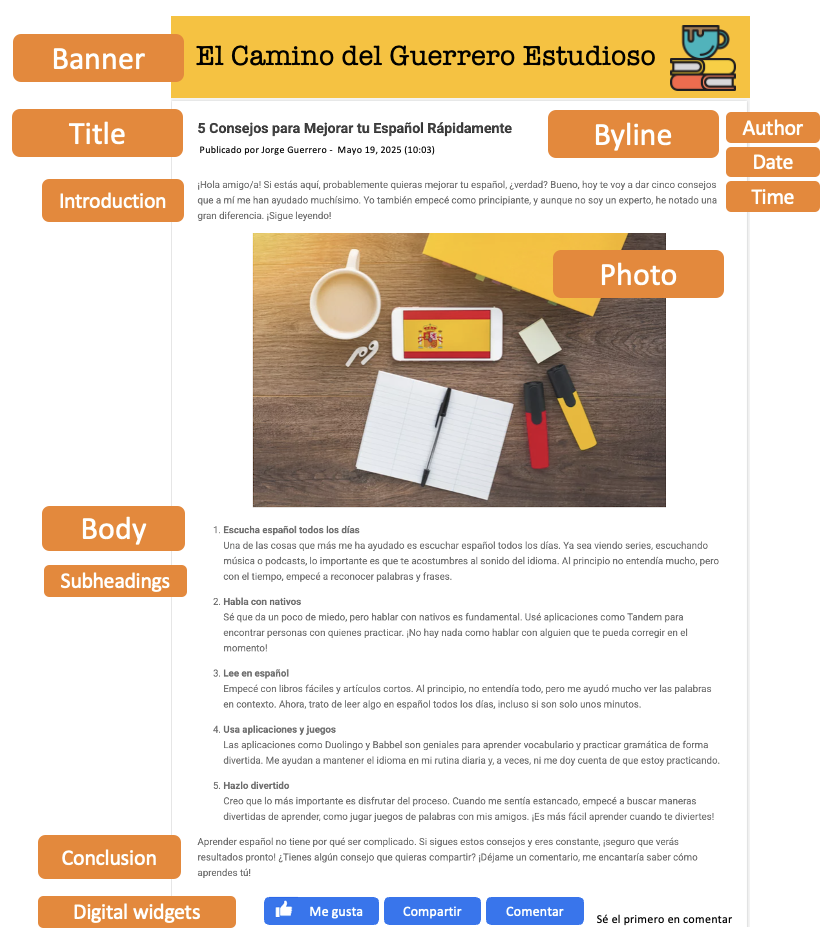
| Context | Audience | Purpose |
|
|
|
Key words
The following key words in the exam may suggest that the appropriate text type is a blog.
|
Español
|
Inglés
|
|---|---|
|
La entrada
|
The post
|
| Los lectores |
The readers
|
| Los seguidores |
The followers
|
| Consejos | Tips |
| Recomendaciones | Recommendations |
|
Compartir
|
To share
|
|
Sugerir
|
To suggest |
| Aconsejar | To advise |
| Recomendar | To recommend |
| Influenciar | To influence |
Key points at a glance
|
Format
|
Message
|
Language
|
|---|---|---|
|
|
Personal blog:
Professional blog:
Both:
|
Key features, tips and examples
- The banner is your blog's brand.
- Make it catchy and relevant to your content and audience.
- Memorize a "one-size-fits-all" cool banner name, and a few specific ones for common topics.
Examples:
- Generic: El Blog de las Mil y Una Astucias (The Blog of the Thousand One Tricks)
- Travel: Mi Bitácora Bloguera (My Travel Blog Log)
- Cooking: De Blog a Boca (From Blog to Mouth)
- Studies: De Cero a Siete con Manolete (From Zero to Seven with Steven)
- Must be relevant.
- May include the word tips (consejos).
Examples:
- Cinco consejos para ser feliz en pareja
- Mi secreto para viajar sin dinero a Japón
- La mejor tortilla española del mundo
- Claves para reducir el estrés durante los exámenes
- Published by: your blogger's name (publicado por)
- Date: It is mandatory.
- Time of publication (recommended): While no longer required in recent IB marking criteria, it was an expectation in previous versions.
Example:
- Publicado por Manolete - Mayo 15, 2025 (10:03 am)
- A good image catches the reader's attention more than words.
- Don't waste valuable exam time by drawing a picture; just draw a box and write the word 'FOTO' in it.
- If you have extra time, you may describe the content of the picture.
Examples:
- Foto de una pareja feliz
- Foto de un mochilero con el Monte Fuji de fondo
- Foto de una deliciosa tortilla de patatas
- Foto de estudiantes haciendo un examen
- Must be relevant: it sets the direction of the post.
- Make it interesting: it is a hook to capture interest.
- Greeting (strongly recommended): While not the most common practice in the blogging world, the IB marking criteria often include this requirement, especially for personal blogs (Section A). A greeting helps establish a friendly and engaging connection with your readers. Although it makes sense to address a plural audience, given the mass media nature of the text, addressing the individual reader is also acceptable. Below some examples with non-binary language.
Examples:
- ¡Hola amigos, amigas y amigues! Últimamente me habéis preguntado si de verdad soy feliz con mi pareja después de tantos años (el mes que viene es nuestro décimo aniversario) y la respuesta es...
- ¡Hola trotamundos! Bienvenid@s a otra pasionante entrada sobre cómo viajar sin dinero. En esta ocasión, ¡nos vamos a Japón! Sí, me habéis oído bien. Japón es uno de los destinos más costosos del mundo, pero yo fui capaz de pasar un mes allí con un presupuesto muy ajustado. Aquí os cuento mi secreto.
- Buenos días, amantes de la buena mesa, ¿qué les parece si hoy hacemos una tortilla española para el almuerzo? No hablo de una tortilla cualquiera, sino de la mejor tortilla de patatas del mundo. Voy a compartir con ustedes la receta de mi abuela, que era gallega. ¡Prepárense para chuparse los dedos!
- ¡Hola estudiantes! Ya llegan los exámenes, que para la mayoría de nosotros se traducen en mucho café negro y noches en blanco. Si tú eres de los que se mueren de los nervios antes de un examen, estos consejos para superar el estrés son para ti.
- Organize your ideas in clear short paragraphs.
- In addition to the structural scaffold (intro - body - conclusion), use subheadings to signpost your content. Match each subheader with a task, both for clarity and to ensure you don't miss any.
- Highlight key ideas with bold font.
- If making lists (e.g., recommendations), use bullet points.
Remember:
- Missing a task will cost you three marks (Criterion B: Message).
- Not using paragraphs will cost you two marks (one in Criterion B: Message, and another one in Criterion C: Conceptual understanding).
- Farewell and closure: The IB marking sheets state a requirement for farewell and closure. A farewell may not necessarily mean using the words 'good bye' or 'see you soon', but a call out to engage the reader. You may end with a final interesting reflection or a provocative question.
- Bloggers build their popularity through readers' comments and shares; therefore, it is common to end with a question or a direct call to action to leave a comment.
Examples:
- ¿Y tú, qué opinas? ¿Has tenido alguna experiencia similar? Cuéntanos cómo te enfrentaste a la situación en los comentarios.
- Espero que estas ideas te hayan servido de inspiración para preparar tu próximo viaje. Si tienes alguna duda o quieres añadir alguna recomendación, deja un comentario.
- Si preparas esta receta en casa, no olvides compartir una foto en los comentarios. ¡Que aproveche!
- Y eso es todo por hoy, compañer@s. Os deseo mucha suerte para los exámenes y, por supuesto, si tenéis algún truco que os ayude a controlar los niveles de estrés, sed solidarios dejando un comentario. ¡Nuestra unión hace nuestra fuerza!
- Although not mandatory, including widgets is highly recommended as they make the text type clearly recognizable.
- Make it look the part: Check real Spanish blogs to observe the most common widgets and their display styles.
Examples:
- Comentarios recientes - Recent comments
- Comentarios destacados - Featured comments
- Etiquetas - Tags
- Archivos - Archives
- Búsqueda - Search
- Entradas recientes - Recent posts
- Entradas populares - Popular posts
- Sobre el autor - About the author
- Enlaces relacionados - Related links
- Redes sociales - Social media links
Test your skills
Escribe entre 70 y 150 palabras.
Tu escuela ha organizado un taller sobre seguridad en internet como parte de una iniciativa de alfabetización digital. Durante el taller, descubres que muchos estudiantes no saben cómo proteger su información personal en línea. Escribe un texto en el que expliques la importancia de la seguridad en línea, describas las medidas clave que los individuos deben tomar para protegerse y resaltes las precauciones esenciales necesarias para navegar por internet de manera segura.
| Artículo | Blog | Folleto |
Reflect
- What would be the second and third best text types for this task?
- What would you have done differently if you were writing an article instead of a blog?
- What would you have done differently if you were writing a brochure instead of a blog?
Click on the link to read a student sample for this prompt. Analyze it before reading the marking notes.
Download: Printable cheat sheet
Activities: El Blog de las Mil y Una Astucias
- Collaborative and creative work: Choose one of the situations suggested by your teacher. In your group, discuss whether you have ever been in a similar situation and how you dealt with it. Use the ideas and anecdotes to write your post.
- Peer feedback: Swap your post with another person from your group to give and receive feedback. Make changes accordingly to perfect your text.
- Reflection: Create a class exhibition by lining up the posts on a wall and reading the work from other groups. Reflect on what they did well and what they could have done better. Use post-its to leave comments.
- Individual work: At home, think about another humorous life situation and write a post with practical tips. Publish it in the class blog.
- Peer feedback: Read the posts from your classmates and write comments with your feedback.
De Profe a Profe
Crea un Blog de Clase y añade a cada uno de tus alumnos como autor, para que puedan publicar su trabajo y leer el de sus compañeros. Pídeles que utilicen etiquetas para formar categorías. Por ejemplo, para esta actividad, la etiqueta podría ser: "Astucias".
Haz clic en este enlace para descargar e imprimir las situaciones. Si lo prefieres, puedes recortarlas y asignar distintas situaciones a cada grupo, para evitar que todos escriban sobre lo mismo.