Tipos de texto (Text types)
Note from the author: Most of the content in this section has been written in English to help students grasp concepts quickly. Subsections intended for teachers are presented in Spanish.
6. Correo electrónico
An email (un correo electrónico) is a digital message sent electronically from one person to another or to a group of recipients. It serves as a common method of communication in both personal and professional settings.
The email and letter serve similar purposes in communication, but a letter is generally more official, especially in professional or legal contexts. Letters carry more weight and are used when a higher level of formality is required. Emails, on the other hand, are preferred for their speed, convenience, and ease of response, making them ideal for everyday personal and professional communication, though they can still be formal when necessary.
Model text and key features
Here are two email models side by side. What differences can you observe between a personal and a professional email?
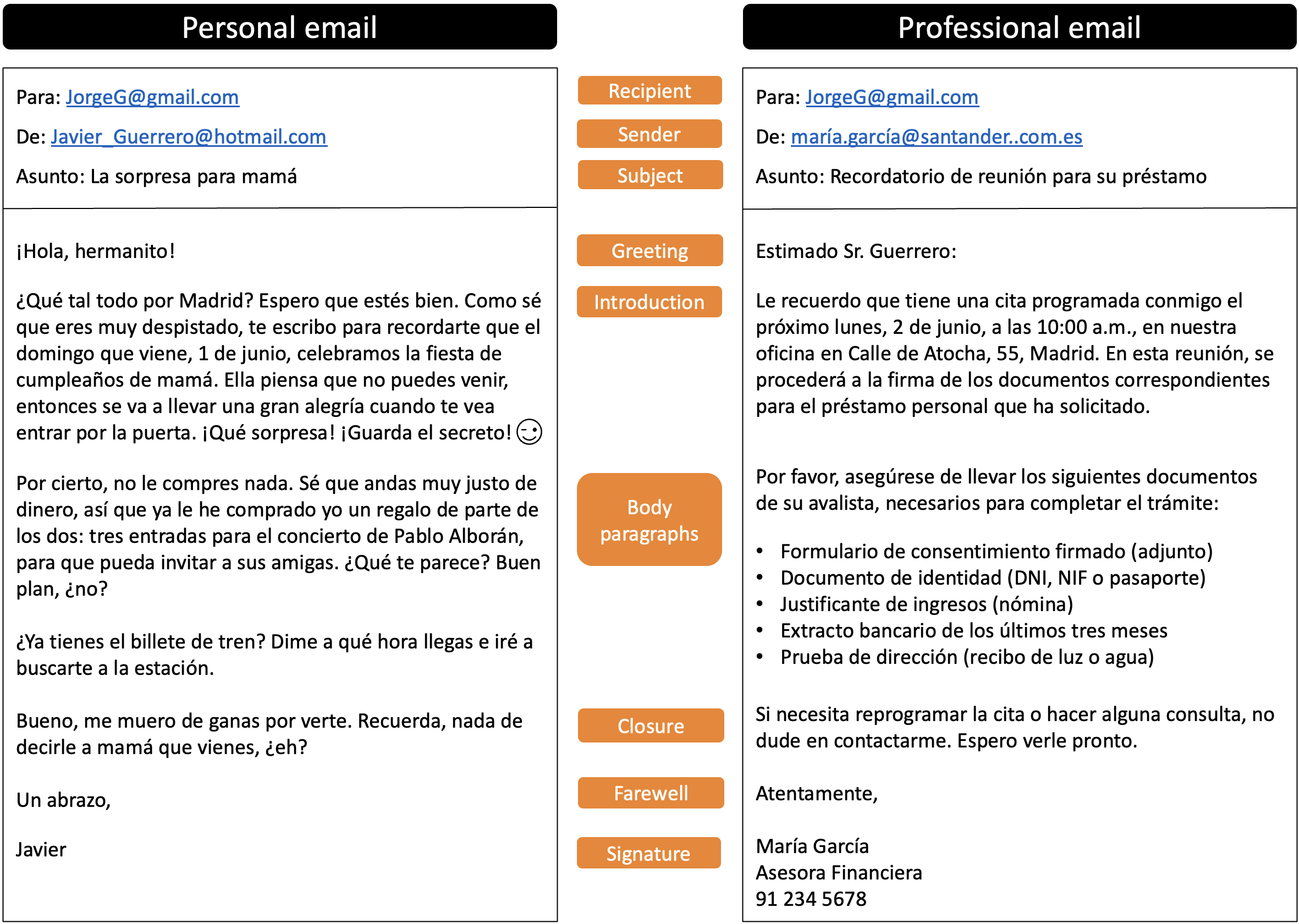
| Context | Audience | Purpose |
|
|
|
Key words
The following key words in the exam may suggest that the appropriate text type is a letter.
|
Español
|
Inglés
|
|---|---|
| Contar | To tell |
|
Dar noticias
|
To give news
|
| Pedir, solicitar |
To request
|
| Proponer | To propose |
| Invitar | To invite |
|
Felicitar, dar la enhorabuena
|
To congratulate
|
|
Agradecer, dar las gracias
|
To thank |
| Protestar, quejarse | To complain |
| Disculparte, pedir perdón | To apologize |
Key points at a glance
|
Format
|
Message
|
Language
|
|---|---|---|
|
|
|
Key features, tips and examples
- To line: contains the email address of the recipient(s) (Para:)
- From line: contains the email address of the sender (De:)
- Subject line: careful, it is not 'sujeto' (Asunto:)
Note:
The sample follows the guidelines provided by the IB in the most current mark schemes. Older mark schemes did not include the sender's line, as this element does not appear when composing the email. However, it does show up when you open an already sent email. In real-life emails, you would also see the date and time the email was sent, but the IB does not require this element, likely to reinforce the distinction between an email and a letter. While this may not seem entirely logical, my recommendation is to follow the conventions shown in the model.
- It must be appropriate to your relationship with the email's receiver.
- Punctuation: In Spanish, the greeting is traditionally followed by a colon, not a comma.
Examples for a personal email:
- ¡Hola, Juan!
- Queridos papá y mamá:
- Querida abuelita:
Examples for a professional email:
- Estimado/a Señor/a:
- Estimado Señor Director: / Estimado Sr. Director:
- Estimada Señora Sanz: / Estimada Sra. Sanz:
- Apreciados Señores: / Apreciados Sres.:
- The introduction sets the tone and purpose of the email.
- It is common to open with polite expressions (e.g., well wishes), although formal professional emails may skip these and go straight to the point.
Examples for a personal email:
- ¿Qué tal estás? Espero que te encuentres bien. Te escribo para contarte que...
- ¿Qué tal os va? Espero que estéis todos bien en casa. Os escribo este correo para daros...
- Espero que este correo te encuentre bien de salud. Te escribo para pedirte...
Examples for a professional email:
- Espero que se encuentre bien. Le escribo para notificarle que...
- Espero que este correo le encuentre bien de salud. Me dirijo a usted para solicitarle...
- Me pongo en contacto con ustedes para informarles de..
- Organize your ideas in clear short paragraphs.
- Use cohesive devices to organize the logical flow of your ideas.
- Aim to write one paragraph per task; this will improve the readability of your email and help ensure that you address all the message requirements.
- Personal emails are expressive and may include exclamation marks and emojis, but these are inappropriate in professional or formal emails.
Remember:
- Missing a task will cost you three marks (Criterion B: Message).
- Not using paragraphs will cost you one mark (Criterion B: Message).
- Personal emails tend to end with a warm, personal closing statement.
- Professional emails tend to end with a formulaic closing statement.
- The closing statement may contain a call to action.
Examples for a personal email:
- Te echo mucho de menos. Espero que me respondas muy pronto.
- Muchos besos y recuerdos a toda la familia. Os extraño mucho.
- ¡Escríbeme pronto! Me muero de ganas por leerte...
Examples for a professional email:
- Le agradezco de antemano su consideración y quedo a la espera de su respuesta.
- En espera de su pronta respuesta, le agradezco la atención prestada.
- Les agradezco su interés y quedo a su entera disposición para cualquier pregunta.
- In personal emails, the farewell should be warm and caring (expressions like 'adiós' and 'gracias' would come across as cold an distant).
- In professional emails, farewells are impersonal and formulaic.
- Never include English symbols such as 'xxx' or 'xoxo,' as they may cause confusion and misunderstandings among Spanish-speaking readers.
Examples for a personal email:
- Con todo mi cariño,
- Muchos besos y abrazos,
- Un beso muy fuerte de tu nieta favorita,
Examples for a professional email:
- Saludos,
- Un cordial saludo,
- Atentamente,
- In a personal email, sign with your name; remember not to use your real name!
- In a professional email, sign with your name and surname.
- In a professional email, you may add your title or role underneath your name.
Test your skills
Escribe entre 70 y 150 palabras.
Vas a pasar un fin de semana de turismo en Madrid con tu familia. Escribe un texto al hotel para reservar dos habitaciones. Debes mencionar algún detalle sobre el tipo de habitación que deseas y hacer alguna pregunta sobre las instalaciones y servicios del hotel.
| Carta | Correo electrónico | Mensaje de texto |
Reflect
- What would be the second and third best text types for this task?
- What would you have done differently if you were writing a letter instead of an email?
- What would you have done differently if you were writing a text message instead of an email?
Click on the link to read a student sample for this prompt. Analyze it before reading the marking notes.
Download: Printable cheat sheet (informal email)
Download: Printable cheat sheet (formal email)
Activities: Querido Javier...
- Collaborative and creative work: In your group, you are going to reply to the personal email sample, pretending to be Jorge. Each person chooses a different outcome from the scenarios provided by your teacher. Discuss ideas and write your reply to your brother's email.
- Peer feedback: Swap your email with another person of your group to give and receive feedback. Make changes accordingly to perfect your text.
- Reflection: Create a class exhibition by lining up the emails on a wall, organized by scenario. Read the emails from students who shared your scenario and reflect on what they did differently. Use a sticker to choose your favorite email. The class’s favorite emails are read aloud and discussed. What was good about them?
- Individual work: Your teacher will randomly assign you an email written by another student. At home, pretend you are Javier and respond to the email from your brother, Jorge.
De Profe a Profe
Haz clic en este enlace para descargar e imprimir las situaciones de la actividad arriba. Una forma sencilla de distribuir los correos de forma aleatoria es pedir a cada estudiante que entregue su texto a un/a compañero/a de clase.
Una bonita idea para trabajar este formato es ponerse en contacto con una escuela de BI de un país hispanohablante para proponer un proyecto de intercambios epistolares por correo. Puedes hacerlo tú o proponer a tus alumnos que tomen la iniciativa como actividad para CAS.