Tipos de texto (Text types)
Note from the author: Most of the content in this section has been written in English to help students grasp concepts quickly. Subsections intended for teachers are presented in Spanish.
8. Diario personal
A journal or personal diary (un diario personal) iis a private record where individuals document their thoughts, feelings, and experiences on a regular basis. It's a reflective practice that allows writers to express themselves freely, without the pressure of an audience, and serves as a tool for personal growth and introspection.
An entry in a journal is similar to a letter written to a best friend.
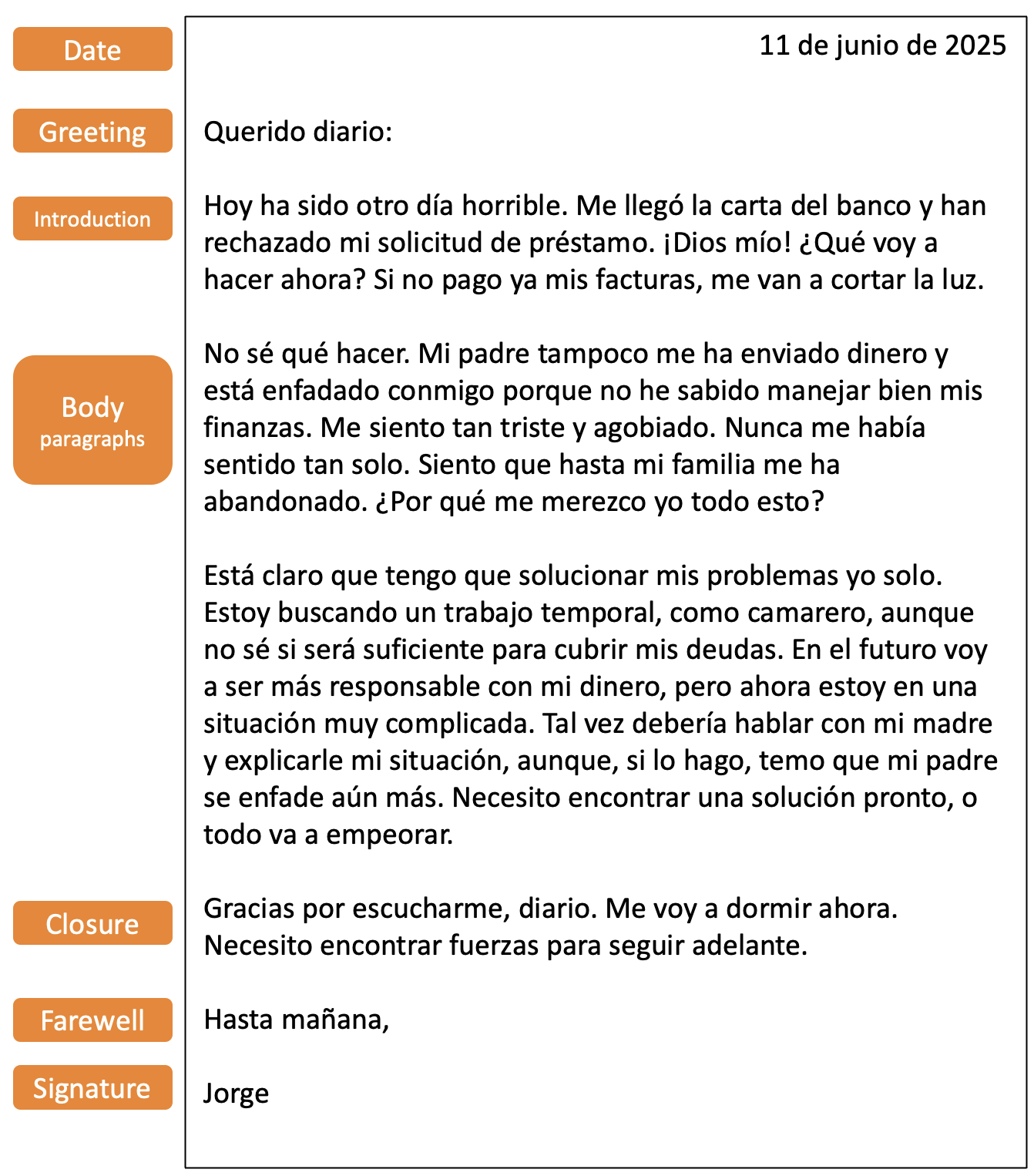
Model text and key features
| Context | Audience | Purpose |
|
|
|
Key words
Identifying this text type as the most appropriate is quite obvious, as the prompt will not mention the audience. The following key words in the exam also suggest that the appropriate text type is a personal diary.
|
Español
|
Inglés
|
|---|---|
| Reflexionar | To reflect |
| Expresar tus pensamientos |
To express your thoughts
|
| Expresar tus reflexiones |
To express your reflections
|
| Expresar tus sentimientos | To express your feelings |
| Decir cómo te sientes | To say how you feel |
|
Desahogarte
|
To vent
|
Key points at a glance
|
Format
|
Message
|
Language
|
|---|---|---|
|
|
|
Key features, tips and examples
- As with letters, your journal entry should include a date.
- The date may be preceded by the city from which you are writing, if this is relevant (for example, you are writing from an unusual location)
- The traditional spot to write the date in Spanish is at the top right-hand corner of the page.
- Remember that days and months are not capitalized in Spanish.
Examples:
- 11 de junio de 2025
- Miércoles 11 de junio de 2025
- Madrid, el 11 de junio de 2025
- The IB expects you to reference your personal diary, so memorize the greeting below.
- Memorize the correct spelling (many Spanish learners mispel the word 'Querido' and write 'Queirido' or 'Quierido')
- Punctuation: In Spanish, the greeting is traditionally followed by a colon, not a comma.
Querido diario:
- The introduction sets the tone of your entry: happy, excited, sad, bored...
- Memorize some sentences that you can easily adapt to the context of the prompt by changing the adjective.
Examples for a good day:
- Hoy ha sido un día increíble / maravilloso.
- Hoy he tenido un día fantástico / emocionante / genial.
- Hoy ha sido el día más feliz de mi vida.
- Hoy ha sido el mejor día de mi vida.
Examples for a bad day:
- Hoy ha sido un día decepcionante / deprimente.
- Hoy he tenido un día horroroso / horrible / fatal.
- Hoy ha sido el día más triste de mi vida.
- Hoy ha sido el peor día de mi vida.
- Organize your ideas in clear short paragraphs.
- Use cohesive devices to organize the logical flow of your ideas, and aim to write one paragraph per task.
- Use exclamation marks and rhetorical questions to set an expressive and reflexive tone.
Exclamations on a good day:
- ¡Qué bien!
- ¡Qué guay! (How cool! Spanish from Spain)
- ¡Qué padre! (How cool! Mexican Spanish)
- ¡Qué chévere! (How cool! Latinamerican Spanish)
- ¡Qué emoción! (How exciting!)
- ¡Qué ganas! (I'm so excited!)
Exclamations on a bad day:
- ¡Qué mal!
- ¡Qué horror!
- ¡Qué rollo! (What a drag!)
- ¡Qué pena! / ¡Qué lástima! (What a pity!)
- ¡Qué rabia! (How annoying!)
- ¡Qué asco! (How disgusting!)
Rhetorical questions:
- ¿Te lo puedes creer? (Can you believe it?)
- ¿Por qué siempre me pasan a mí estas cosas? (Why do these things always happen to me?)
- ¿Qué habré hecho para merecer esto? (What did I do to deserve this?)
- ¿Qué puedo hacer yo ahora? (What can I do now?)
- ¿Te parece justo? (Does it seem fair to you?)
- Because people often write in their diaries at night to reflect on the events of the day, your closing statement may include a reference to bedtime.
- You can memorize one or more of the following examples and combine them.
Examples:
- Es tarde, mejor me voy a la cama. (It's late, I better go to bed).
- Ya son las once, tengo que irme a dormir. (It's already eleven, I have to go to sleep).
- Mañana escribiré más. (I will write more tomorrow).
And on a particularly bad day:
- Mañana será otro día. (Tomorrow will be another day).
- As with the closing statement, it may simply refer to bedtime.
- Remember that your diary is your imaginary best friend, hence it must be informal. A formal farewell will cost you one mark for Criterion C (Conceptual Understanding).
Examples:
- Buenas noches, diario.
- Hasta mañana, mi diario.
As with informal letters, sign your journal entry with your fake Spanish name.
Test your skills
Escribe entre 70 y 150 palabras.
Hoy has ido a una protectora de animales para adoptar una mascota. Tienes muchos sentimientos encontrados. Escribe un texto para expresar tus emociones. Debes explicar qué animal elegiste y por qué, cómo te sientes y qué vas a hacer para ayudar a los otros animales.
| Blog | Diario personal | Discurso |
Reflect
- What would be the second and third best text types for this task?
- What would you have done differently if you were writing an blog instead of a journal?
- What would you have done differently if you were writing a speech instead of a journal?
Click on the link to read a student sample for this prompt. Analyze it before reading the marking notes.
Download: Printable cheat sheet
Activities: Querido Diario...
- Collaborative and creative work: In pairs, you will receive a visual prompt to set the tone of your diary entry. Brainstorm some ideas and write it together, making sure to include appropriate exclamatory sentences and rhetorical questions.
- Collaborative work and reflection: Your teacher will ask you to write a number in the corner of your text. This way, when all the copies are collected, they will be divided into two groups: even and odd numbers. If your text has an even number, you must read the texts from the odd group, and vice versa. On the table, you will find cards with all the visual prompts. Work collaboratively to match each text with the most appropriate visual prompt. Highlight the words and sentences that helped you identify the feeling.
- Peer feedback and reflection: Once the time is up for the card-text matching activity, check whether your diary entry has been matched to the correct prompt and provide feedback to the other team. Discuss the activity: Which texts were more clearly linked to the visual prompt and why? What did you learn from reading other people's work? Is there a diary entry that stood out to you? If there is enough time, two or three favorite diary entries may be read aloud.
De Profe a Profe
Aquí tienes las tarjetas con los emoticonos para imprimir y recortar. Esta actividad es perfecta para trabajar los adjetivos de las emociones y, por lo tanto, es ideal para un repaso de contenidos del primer año de curso.
Te propongo una segunda actividad, de nivel más avanzado, con el objetivo de trabajar el pretérito perfecto compuesto. El diario personal nos ofrece una magnífica oportunidad de trabajar este tiempo verbal complejo. La actividad está basada en la canción titulada "Un buen día", de Los Planetas.
Actividad de 'Un Buen Día', paso a paso:- Hoja de trabajo: Reparte a tus alumnos esta hoja de trabajo con la letra de la canción y pídeles que conjuguen los verbos entre paréntesis en pretérito perfecto compuesto (habrás notado que no he utilizado toda la letra de la canción, para evitar la alusión a las drogas, que podría resultar inapropiada para su uso en clase.).
- Corrección y reflexión: Corrige la actividad en sesión plenaria y aprovecha para resaltar y discutir el uso de otros tiempos del pretérito en la canción, como el imperfecto o pluscuamperfecto.
- Vídeo, discusión y lluvia de ideas: Visiona el vídeo y discute con los alumnos el título de la canción: ¿Realmente ha sido un buen día para el protagonista de la canción? ¿Cómo se siente y por qué? Realiza una lluvia de ideas con tu clase y escribe en la pizarra los adjetivos que describen los sentimientos del protagonista.
- Trabajo individual: Como tarea para casa, pide a tus alumnos que se pongan en la piel del protagonista de la canción y escriban una entrada en su diario personal, explicando cómo ha sido su día, cómo se siente y qué va a hacer para que mañana sea, de verdad, un buen día.
Si lo prefieres, puedes utilizar las actividades interactivas de VideoEle (son estupendas, pero debo advertirte que incluyen material controvertido).