Tipos de texto (Text types)
Note from the author: Most of the content in this section has been written in English to help students grasp concepts quickly. Subsections intended for teachers are presented in Spanish.
9. Discurso / Presentación
A speech or presentation (un discurso o una presentación) is a text that is read or spoken publicly with the aim of clearly and orderly conveying feelings and thoughts about a specific topic. A speech is typically addressed to a large audience with the purpose of sharing ideas, raising awareness, motivating, persuading, and gaining support for a particular cause or agenda.
Model text and key features
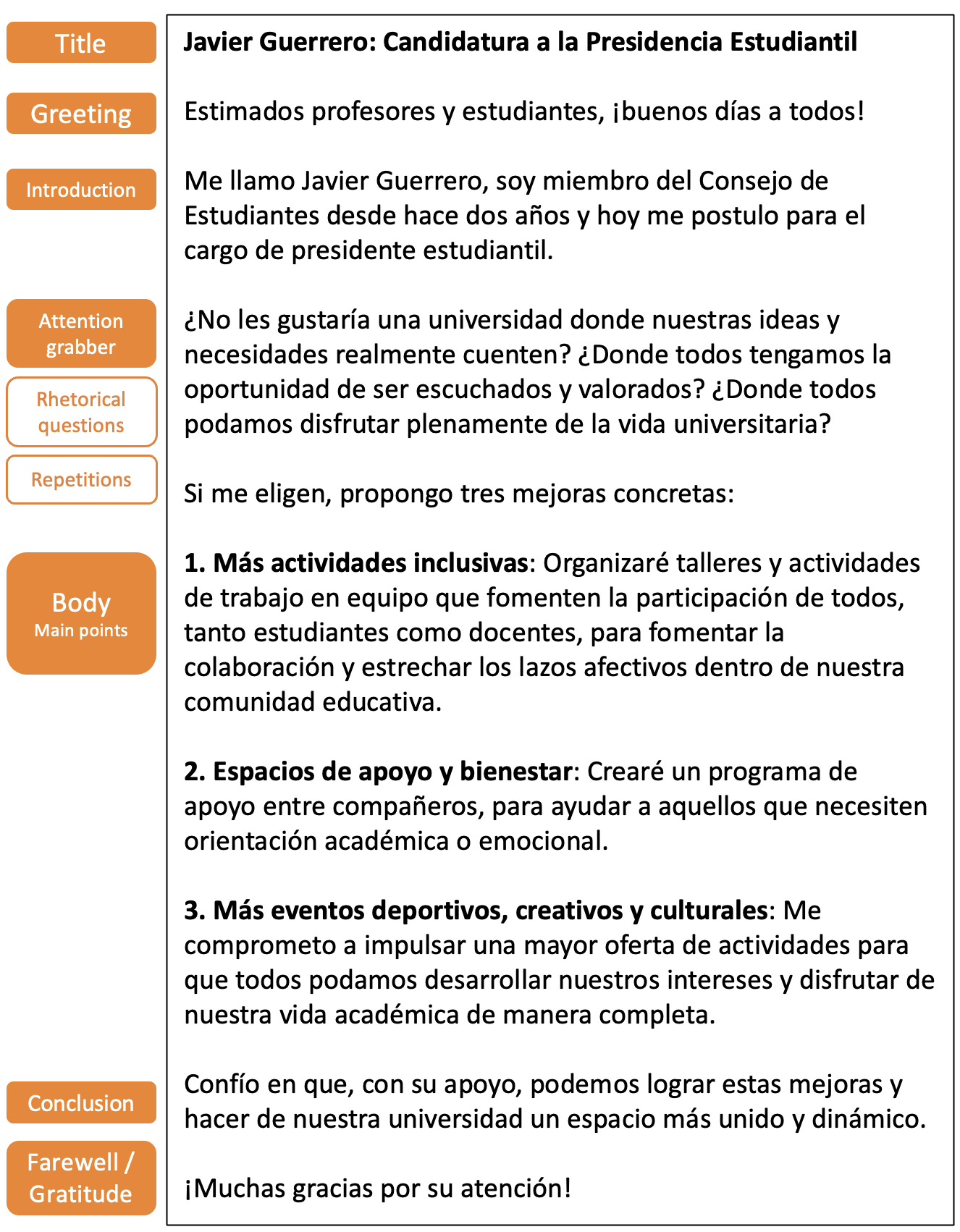
Model 1: Electoral speech (discurso electoral)
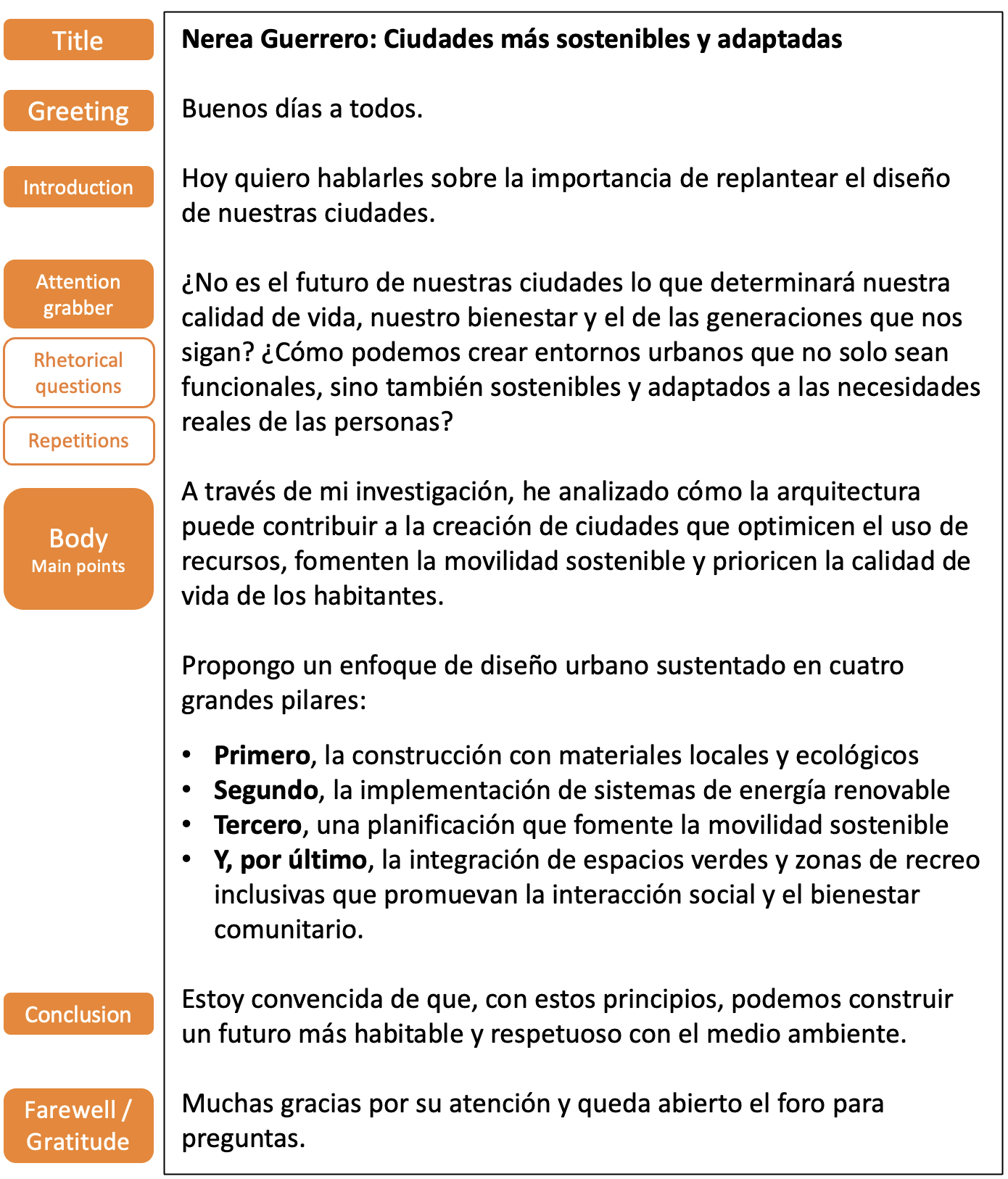
Model 2: Academic presentation (presentación académica)
| Context | Audience | Purpose |
|
|
|
Key words
The following key words in the exam also suggest that the appropriate text type is a speech or presentation.
|
Español
|
Inglés
|
|---|---|
| Informar, explicar | To inform, to explain |
| Exponer, presentar |
To present
|
| Transmitir, expresar |
To convey, to express
|
| Compartir | To share |
| Debatir | To debate |
|
Concienciar, sensibilizar
|
To raise awareness, to sensitize
|
|
Persuadir, convencer, influenciar
|
To persuade, to convince, to influence
|
|
Motivar, inspirar
|
To motivate, to inspire
|
|
Promover, promocionar
|
To promote
|
|
Conseguir apoyo / votos
|
To gain support / votes
|
Key points at a glance
|
Format
|
Message
|
Language
|
|---|---|---|
|
|
|
Key features, tips and examples
When asked to write a speech or presentation in an IB exam, you must transcribe the oral speech; that is, you should write the text as if it were the transcript that the presenter will read aloud. Although you may not read aloud the title of your speech or presentation, remember to include one, as the title is a compulsory element for this text format according to IB mark schemes. It may include the name of the speaker. It can also be a question.
Examples:
- Javier Guerrero: Candidatura a la Presidencia Estudiantil
- Ciudades más sostenibles y adaptadas (por Nerea Guerrero)
- ¿Por qué creemos en lo que creemos?
Although real-life speeches do not always include a greeting, make sure to include one in your speech or presentation. Addressing your audience at the beginning of your text will give you the opportunity to demonstrate your conceptual understanding, which is key to achieving a good score under Criterion B and C.
Examples:
- Estimados profesores y estudiantes, buenos días.
- Compañeros, buenos días a todos y bienvenidos a...
- ¡Hola a todos!
- The introduction sets the purpose of your speech or presentation.
- It should be clear, direct and concise.
- You may introduce yourself, if it is relevant to the context.
Examples:
- Me llamo..., soy..., y hoy vengo a explicarles / plantearles / proponerles...
- Hoy quiero hablarles sobre/de...
- Mi propósito en esta presentación es...
- Hoy tengo el honor de presentar las conclusiones de nuestro estudio sobre...
- En esta presentación, voy/vamos a abordar el importante tema de...
- Hoy me gustaría suscitar una reflexión sobre una cuestión de vital importancia para...
Good public speakers capture the audience's attention by employing a variety of rhetorical devices, such as:
- Rhetorical questions
- Repetition
- Pauses and emphasis
These techniques help to engage listeners and reinforce key messages, making the speech more impactful and memorable.
Examples:
- ¿Alguna vez se han preguntado qué pasaría si...? (Have you ever wondered what would happen if...?)
- ¿A quién no le gustaría...? (Who would not like...?)
- ¿Se imaginan un mundo en el que...? (Can you imagine a world where...?)
- ¿Qué pensarían si les dijese que...? (What would you think if I told you that...?
- Have a clear and direct message, divided in key points.
- Use sequencial connectors to organize your speech.
Examples:
- Primero / En primer lugar, (Firtsly).
- En segundo / tercer lugar (Secondly / Thirdly).
- Por último / Finalmente (Lastly / Finally).
- Por un lado... Por otro lado (On the one hand... on the other hand).
- Por una parte... Por otra parte (On the one hand... on the other hand).
- End your speech with a summary of the key takeaways.
- You may finish with a strong statement, a final thought, or a question that is impactful and memorable.
- You can also conclude with a call to action.
- Be sure to sound decisive and confident.
Examples:
- En conclusión, / En suma, / En definitiva,...
- Quisiera terminar con una última reflexión/pregunta... (I would like to end with a final reflexion/question...).
- Por todo ello, no me cabe la menor duda de que... (For all these reasons, I have no doubt that...).
- Por todas estas razones, tengo la certeza absoluta de que... (For all these reasons, I am absolutely certain that...).
You may end with a note of gratitude or an invitation to ask questions.
Examples:
- Muchas gracias por escucharme.
- Les agradezco su atención.
- Si tienen alguna pregunta para mí, estaré encantado/a de responderla.
Test your skills
Escribe entre 70 y 150 palabras.
Cada vez son más los animales callejeros y las mascotas abandonadas en tu ciudad. Escribe un texto para concienciar a tu comunidad sobre la difícil situación de estos animales, explicar los desafíos que enfrentan las protectoras y proponer medidas para mejorar la situación.
| Carta | Discurso | Informe |
Reflect
- What would be the second and third best text types for this task?
- What would you have done differently if you were writing a report instead of a speech?
- What would you have done differently if you were writing a letter instead of a speech?
Click on the link to read a student sample for this prompt. Analyze it before reading the marking notes.
Download: Printable cheat sheet
Activities: Dilemas a debate
- Reflection: Your teacher will present you with a dilemma, and you must choose one of the given options. Note that selecting one option excludes the others.
- Collaborative and creative work: Based on your answer to the dilemma, your teacher will assign you to a work group. In your group, you will brainstorm ideas to convince the rest of the class of the merits of your chosen option and the detriments of the others. Together, you will write a speech lasting two to five minutes, paying attention to structure and rhetorical devices.
- Peer feedback and reflection: One person from each team will read their speech aloud. At the end of the speeches, students will provide feedback to the other teams: What was good about their speeches? What could they have improved? Which speech was the most convincing? Have any of you changed your original views on the dilemma? What made you change your opinion?
De Profe a Profe
Aquí tienes una serie de dilemas que puedes utilizar para la actividad. Te sugiero varias opciones para que puedas elegir la que mejor se adapte al tamaño de tu clase y a la temática u objetivos gramaticales que estés trabajando.
Te propongo una segunda actividad, con conexiones a la TdC. En esta breve (6,34 minutos) pero impactante charla para TEDxBariloche, el reconocido sociólogo y filósofo estadounidense John Millburgh cuestiona los fundamentos de nuestras creencias.
Actividad de '¿Por qué creemos en lo que creemos?', paso a paso:
- Introducción: Explica a la clase que van a ver una breve charla de un reconocido sociólogo y filósofo estadounidense, John Millburgh, del que seguramente habrán oído hablar en sus clases de TdC o de psicología.
- Vídeo e interacción: Puedes usar el vídeo como estímulo para la producción oral. Detén el vídeo después de cada una de las tres preguntas iniciales y pide a tus alumnos que respondan y justifiquen sus creencias. Aunque el orador habla de modo pausado y con un vocabulario bastante asequible, te recomiendo que actives los subtítulos en español, si no desde el principio, al menos después de la introducción.
- Discusión y reflexión: Tras visionar la charla, pregunta a tus alumnos qué han opinado sobre la misma. Guía la discusión para que reflexionen tanto sobre el fondo como la forma del discurso. ¿Qué recursos ha utilizado el orador para captar la atención del público, para dar fuerza y credibilidad a sus argumentos y para producir un impacto memorable? Aprovecha para recordar a tus alumnos que durante las pruebas productivas del BI (oral y escrita), no se tendrán en cuenta ni la veracidad fáctica ni la validez o mérito de sus argumentos y opiniones, pero sí la coherencia y convicción con que se presenten. Anima a tus estudiantes a usar los recursos analizados (p.ej., el apoyo en estudios y datos estadísticos) durante el examen.
- Trabajo individual: En casa, piensa en una creencia personal o colectiva que deberíamos cuestionar. Escribe un discurso o presentación, en el que el título sea una pregunta provocativa.
Te recomiendo que propongas esta actividad como tarea durante las vacaciones. A su regreso, recoge todos los discursos para corregirlos. Seguramente encuentres alguno interesante que pueda encajar dentro de la temática que estés dando o repasando y te pueda servir como gancho para empezar una lección o unidad. Trabaja con tu alumno/a para mejorar su discurso o presentación y pídele que lea el discurso o haga su presentación en clase. Si es una persona muy tímida, puedes pedirle que te dé permiso para hacerlo tú en su lugar.