Tipos de texto (Text types)
Note from the author: Most of the content in this section has been written in English to help students grasp concepts quickly. Subsections intended for teachers are presented in Spanish.
10. Entrevista
An interview (una entrevista) is a structured conversation between two or more people where questions are asked by the interviewer to elicit information or opinions from the interviewee.
There are many types of interview based on context and purpose (e.g., job interview, exit interview, research interview...). In this section, we will focus on the journalistic interview.
A journalistic interview is a form of structured conversation used by journalists to gather information, opinions, or personal stories from an individual (the interviewee) on a particular subject of interest. It is commonly featured in newspapers, magazines, or digital media platforms.
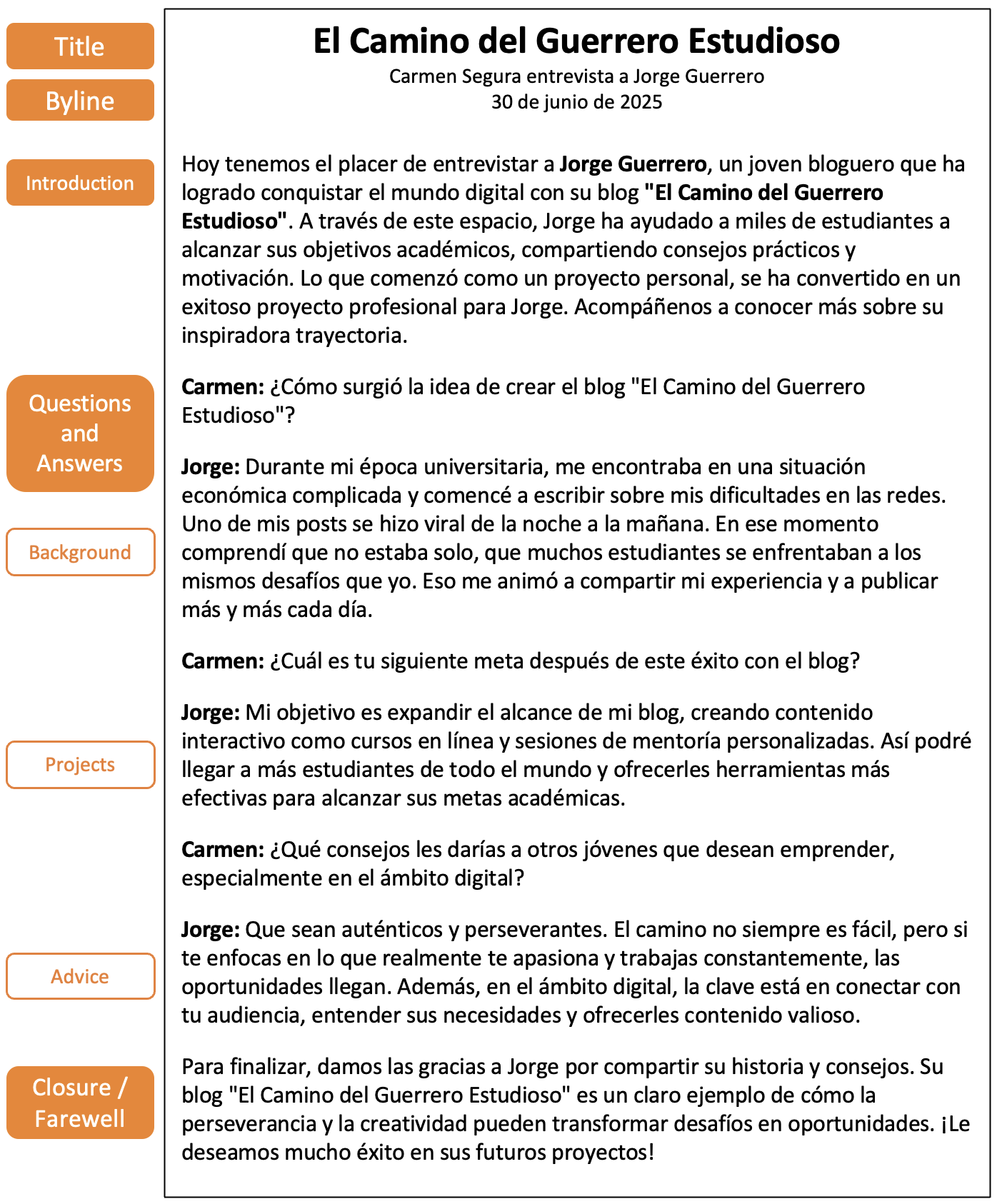
Model text and key features
| Context | Audience | Purpose |
|
|
|
Key words
The following key words in the exam also suggest that the appropriate text type is a speech or presentation.
|
Español
|
Inglés
|
|---|---|
| Periódico, diario | Newspaper |
| Revista |
Magazine
|
| Entrevistar |
To interview
|
| Preguntar, hacer preguntas | To ask questions |
| Compartir la conversación | To share the conversation |
| Informar | To inform |
| Contar |
To tell
|
|
Inspirar
|
To inspire
|
Key points at a glance
|
Format
|
Message
|
Language
|
|---|---|---|
|
|
|
Key features, tips and examples
As with the article, write a catchy title that hints at the subject’s story or focus.
Examples:
- El Camino del Guerrero Estudioso
- Entrevista a Jorge Guerrero: La trayectoria de un bloguero exitoso
- A good image catches the reader's attention more than words.
- Don't waste valuable exam time by drawing a picture; just draw a box and write the word 'FOTO' in it.
- If you have extra time, you may describe the content of the picture. How would you describe the picture in the model interview? Try before reading my suggestions below.
Examples:
- Foto de Jorge escribiendo en su blog
- Foto del blog de Jorge
- Foto de Jorge
- These elements are optional, but recommended.
- Don't use your real name; create a cool Spanish pseudonym to preserve the anonymity of the evaluation process.
- There is no need to signpost the elements with key words such as 'fecha' or 'autor'.
Examples:
- Carmen Segura entrevista a Jorge Guerrero - 30 de junio de 2025
- Entrevista de Carmen Segura a Jorge Guerrero - 30 de junio de 2025
- Por Carmen Segura - 30 de junio de 2025
A short paragraph that introduces the interviewee, their background, and why they are relevant to the topic.
Examples:
- Hoy tenemos el placer de entrevistar a..., conocido/a por...
- Hoy tengo el honor de entrevistar a..., famoso/a por...
- Analize the prompt to identify the tasks, and write at least one question per task.
- Write questions that allow you to showcase your knowledge of different verb tenses: background, inspiration, future projects...
- You may include follow-up questions to encourage the interviewee to justify and/or elaborate on a previous statement.
- A great final question could be one that asks for advice that will be of interest to the readers.
Examples:
- ¿Cuál fue tu inspiración para...? / ¿Cómo empezaste a...?
- ¿Cuál es tu próxima meta? / ¿Estás trabajando en algún nuevo proyecto?
- Para terminar, ¿qué consejos/recomendaciones darías a...? / Por último, ¿qué les dirías a...?
- Summarize the key takeaways from the interview.
- Thank the interviewee for their time and insights.
- Wish them luck and success for their future endeavours.
Examples:
- Para finalizar, damos las gracias a Jorge por compartir su historia y consejos.
- Gracias, Jorge, por tu tiempo y por servirnos de inspiración.
- Le/Te deseamos mucho éxito en sus/tus futuros proyectos.
Test your skills
Escribe entre 70 y 150 palabras.
Una antigua alumna de tu escuela se ha convertido en una deportista profesional. Ha sido invitada a dar una charla en tu escuela y tú la has entrevistado para la revista del colegio. Escribe un texto en el que compartas detalles sobre su trayectoria y sus consejos.
| Artículo | Blog | Entrevista |
Reflect
- What would be the second and third best text types for this task?
- What would you have done differently if you were writing an article instead of an interview?
- What would you have done differently if you were writing a blog instead of an interview?
Click on the link to read a student sample for this prompt. Analyze it before reading the marking notes.
Download: Printable cheat sheet
Activities: Entrevista a un compañero/a de clase
- Work in pairs: In pairs, students interview each other based on a fun or meaningful theme. You may use or get inspired by some of these 20 suggested questions.
- Individual work: Each student writes a short interview about their partner, using a strong introduction.
- Peer feedback and reflection: Students swap their interviews and reflect:
- Were the views and personality of the interviewee effectively captured?
- Was the flow and structure easy to follow?
- Was the interview engaging and interesting to potential readers?