Tipos de texto (Text types)
Note from the author: Most of the content in this section has been written in English to help students grasp concepts quickly. Subsections intended for teachers are presented in Spanish.
14. Mensaje de texto / Mensaje o Nota
A text message (un mensaje de texto) is a brief and direct digital communication between people, usually sent via mobile phone or messaging app.
A message or note (un mensaje o una nota) is a short written message, often handwritten and left in a physical place (like the fridge, a desk, or a door), to inform, remind, or request something.
Model text and key features
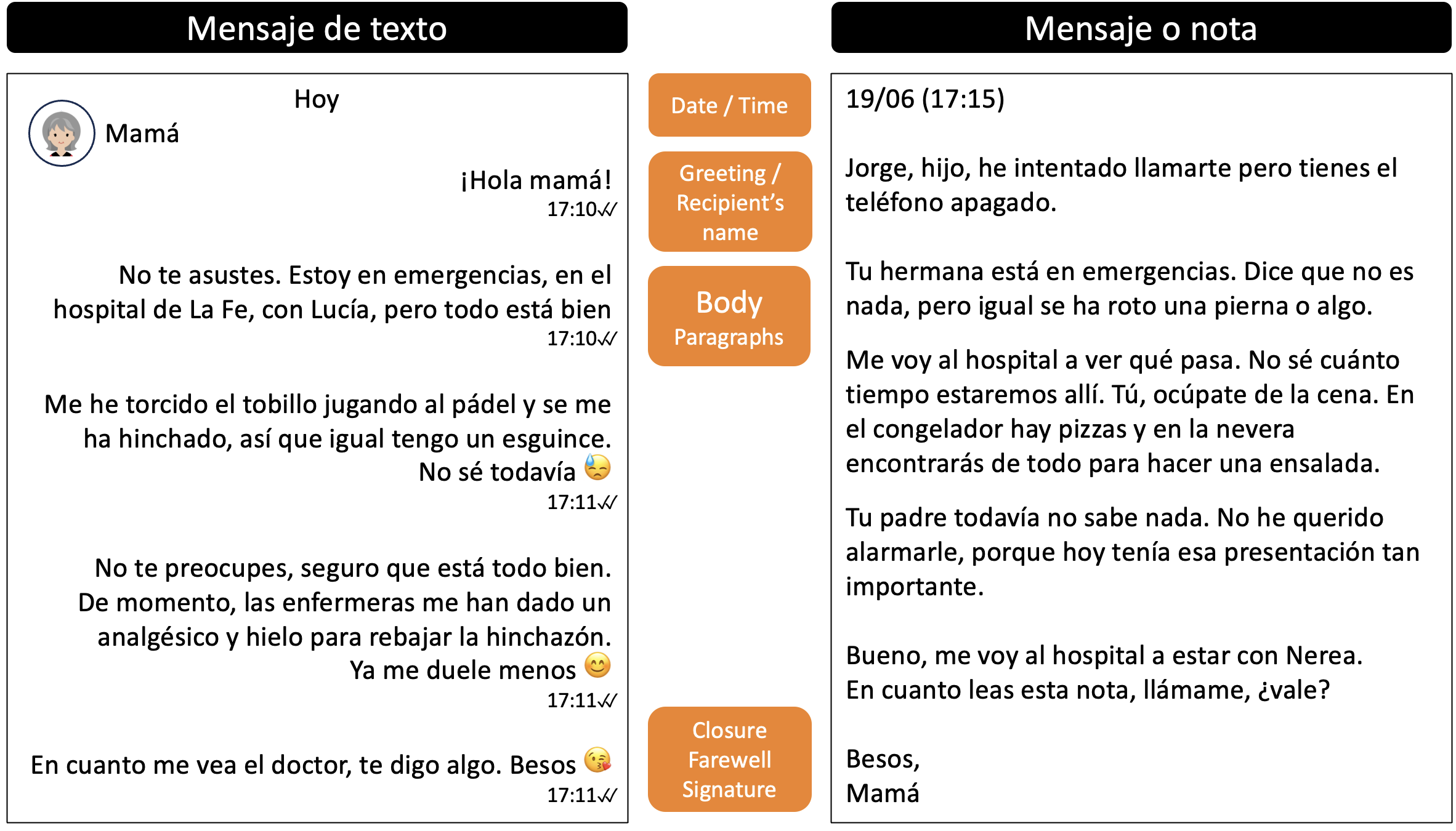
Here are two models side by side. What differences can you observe between a text message and a handwritten note?
| Context | Audience | Purpose |
|
|
|
Key words
The following key words in the exam may suggest that the appropriate text type is a message (mensaje).
|
Español
|
Inglés
|
|---|---|
| Decir | To tell |
|
Informar
|
To inform
|
| Pedir |
To request
|
| Proponer | To propose |
| Sugerir | To suggest |
| Invitar | To invite |
|
Quedar
|
To meet up (make a plan) |
| Recordar | To remind |
Key points at a glance
|
Format
|
Message
|
Language
|
|---|---|---|
|
|
|
Key features, tips and examples
- In a text message, the mobile phone or messaging app will have the date at the top of the chain of messages (on the day the message is being written it will say 'Hoy') and the time after each block of text sent.
- In a handwritten note, the IB requires the date. Depending on the content of the message, including the time may make even more sense.
- In a text message, the photo/avatar and name of the recipient appear in the top-right corner of the screen.
- In a handwritten note, you must clearly specify who the message is intended for.
- You may begin your text message or handwritten note with a brief greeting (e.g., Hola).
- Whether you are writing a text message or a handwritten note, the message should be structured in short paragraphs.
- In text messages especially, you may add emojis to help convey tone.
Useful sentences:
- Por favor, encárgate de preparar… / ocúpate de preparar… (Please, take care of preparing...)
- Recuerda… / No olvides… (Remember / Don't forget...)
- He pensado que podríamos ir a… (I thought we could go to...)
- ¿Te gustaría ir a…? / ¿Te apetece venir conmigo a…? (Would you like to go to...? / Do you feel like coming with me to...?)
- ¿Qué te parece si vamos a…? / ¿Por qué no te vienes conmigo a…? (What do you think if we go to... ? / Why don't you come with me to...?)
- The IB mark scheme requires one of the following elements at the end of the text message or note: farewell, closure or signature.
- The farewell should be brief (e.g., Besos)
- You may sign with your name or initials.
- Remember to use a fake Spanish name.
Test your skills
Escribe entre 70 y 150 palabras.
El próximo lunes es el cumpleaños de vuestro/a profesor/a de español y, junto con tu mejor amigo/a de clase, habéis decidido organizar una pequeña sorpresa en clase. Escribe un texto dirigido al resto de la clase para informarles, explicar vuestras ideas y pedir su colaboración.
| Correo electrónico | Invitación | Mensaje de texto |
Reflect
- What would be the second and third best text types for this task?
- What would you have done differently if you were writing an email instead of a text message?
- What would you have done differently if you were writing an invitation instead of a text message?
Click on the link to read a student sample for this prompt. Analyze it before reading the marking notes.
Download: Printable cheat sheet
Activities: Notas misteriosas
- Collaborative and creative work: The class is split into two groups. Each student must write a short mistery note to a student from the other group. In your group, decide who is writing to whom, to ensure every student is receiving only one note (if the number of student is uneven, one student may write to two students, or two students may collaborate to write a single note). These are the rules for writing the notes:
- Do not include your name or the recipient's name.
- Leave 2–3 clues that hint at your identity and the identity of the person you're writing to.
- Use realistic details: inside jokes, habits, shared memories, class references, hobbies, etc. (example: "Hola,
¿Otra vez dejaste tu libro de biología en la mesa del fondo? Siempre dices que vas a organizarte mejor 😅. Lo tengo yo, te lo doy después de clase.
PD: La portada todavía tiene el dibujo de tu gato.")
- Reading and collaborative work: The groups swap notes. Each group reads the messages they received and works together to guess who wrote each note and to whom.
- Reveal and confirm: Each group presents their guesses. The original writers confirm or correct their identities and explain the clues.
- Discussion and reflection (optional): What clues were most helpful? Which notes were hardest to decode? What vocabulary or expressions did you learn?
De Profe a Profe
Al terminar la actividad de las notas misteriosas, como conclusión de la lección, recuerda a tus alumnos lo importante que es no olvidarse de aclarar la identidad del emisor y del destinatario en el examen.
Una forma bonita de comenzar esta lección es escribir una pequeña nota personal para cada alumno y dejarla sobre su pupitre antes de que lleguen a clase.