Tipos de texto (Text types)
Note from the author: Most of the content in this section has been written in English to help students grasp concepts quickly. Subsections intended for teachers are presented in Spanish.
15. Postal
A postcard (una postal) is a brief personal message typically written on a postcard and sent from one person to another. It often shares travel experiences, vacation highlights, or personal greetings from a specific location.
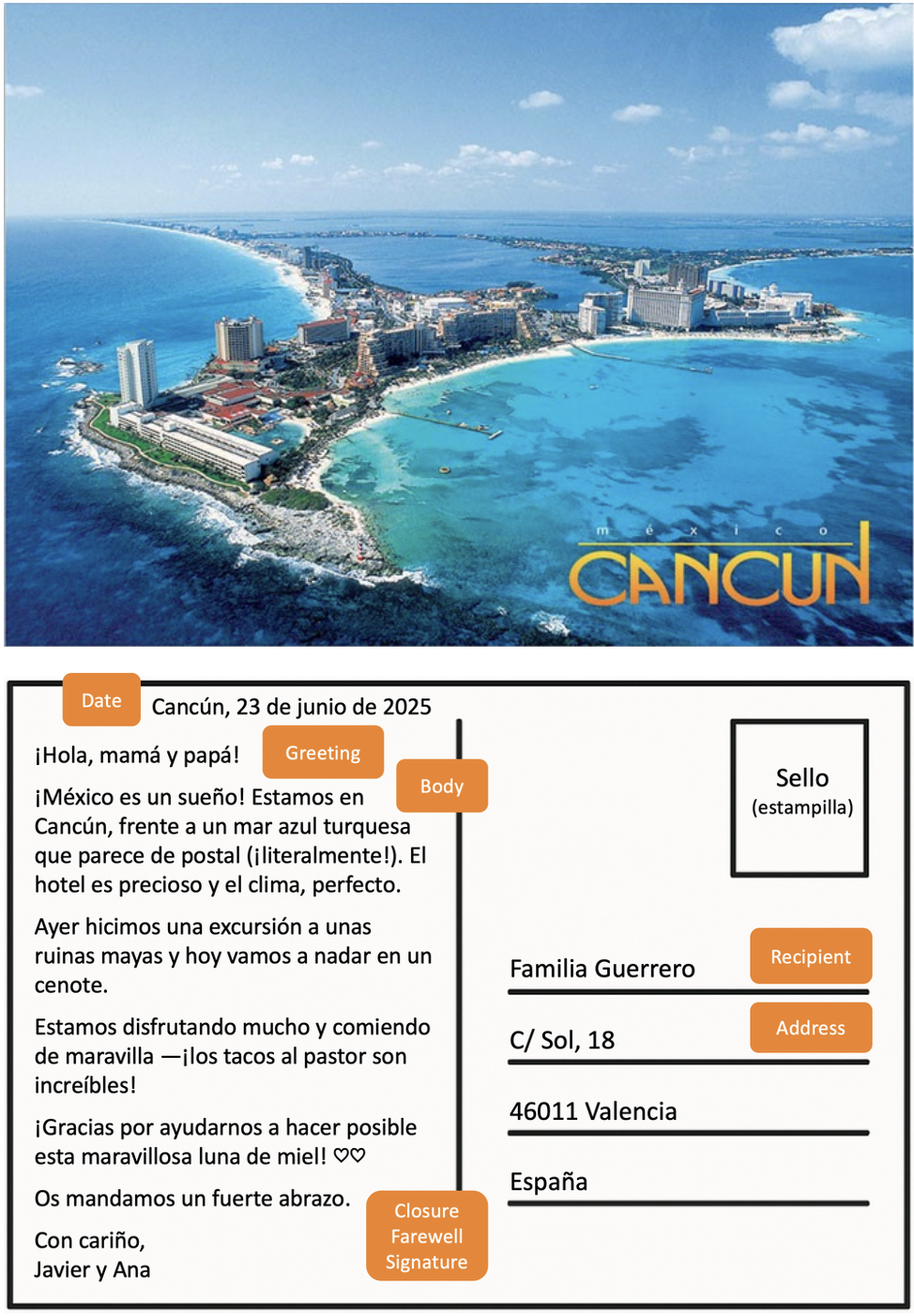
The front of the postcard usually shows a picture representing the place visited. The text is written on the back of the card: the stamp and address go on the right side, while the date and message go on the left. In the exam, you only need to represent the back of the postcard.
Model text and key features
| Context | Audience | Purpose |
|
|
|
Key words
The following key words in the exam may suggest that the appropriate text type is a postcard (postal).
|
Español
|
Inglés
|
|---|---|
|
Informar
|
To inform
|
|
Dar noticias
|
To give news
|
| Compartir |
To share
|
| Las vacaciones |
Holidays
|
| El viaje |
Trip
|
| El campamento |
Camp
|
| La estadía, la estancia |
Stay
|
Key points at a glance
|
Format
|
Message
|
Language
|
|---|---|---|
|
|
|
Key features, tips and examples
- Draw a square with the word 'sello' or 'estampilla' (stamp)
- Write the name and surname of the recipient.
- Write the recipient's address (you may memorize an easy Spanish address).
Example:
Famiia Guerrero
C/ Sol 18
46011 Valencia
España
- Write the name of the place from where you are writing and the date.
- Remember that you can't use ordinal suffixes in Spanish dates (e.g. 23rd) and that months are not capitalized.
Examples:
- Cancún, 23 de junio de 2025
- Cancún, 23/06/25
Postcard greetings tend to be informal, as they are normally sent to family or friends.
Examples:
- ¡Hola, mamá y papá!
- ¡Hola, Nerea!
- Querida abuelita:
- Because of the lack of space in a postcard, paragraphs are short.
- In the opening line mention where you are and how you feel. You may also mention for how long you have been travelling.
- Write about the highlights of your trip: what you are doing, what you have visited, what you are planning...
- It is also quite common to mention the weather and food.
Examples of opening line:
- ¡México es un sueño/paraíso!
- ¡Ya estoy/estamos en México!
- Te/Os escribo/escribimos desde Cancún.
- Ya llevo/llevamos una semana viajando por México.
Examples of highligths:
- Estoy/Estamos disfrutando mucho de...
- Ayer hice/hicimos una excursión a...
- Hace muy buen tiempo/muy bueno.
- La comida es increíble/deliciosa.
- You may end the postcard with an overal opinion or statement about how you feel.
- The closure often includes a wish or loving statement.
- The farewell should be short and warm (e.g., Besos).
- Sign with your fake Spanish name or with an initial.
Examples:
- Lo estamos pasando genial, pero os echamos de menos. (We're having a great time, but we miss you).
- ¡Ojalá estuvieras aquí conmigo! (I wish you were here with me!)
- Ojalá pudieras estar aquí... (I wish you could be here...)
- ¡Nos vemos muy pronto! (See you very soon!)
Test your skills
Escribe entre 70 y 150 palabras.
Llevas una semana de campamento de verano en un país hispanohablante. Escribe un texto a tus padres para contarles cómo te sientes, cómo está siendo tu experiencia en el campamento y qué planes tienes para los próximos días.
| Blog | Carta | Postal |
Reflect
- What would be the second and third best text types for this task?
- What would you have done differently if you were writing a letter instead of a postcard?
- What would you have done differently if you were writing a blog instead of a postcard?
Click on the link to read a student sample for this prompt. Analyze it before reading the marking notes.
Download: Printable cheat sheet
Activities: Dados del Destino
- Preparation: In pairs or groups of three, roll the three dice with prompts for your location, companion, and mood. Record the result of the roll on this planning sheet.
- Collaborative and creative work: Write a postcard to your best friend, based on the dice prompts. You must speak about how you feel and what you are doing; what you have done and what you are planning to do; the landscapes, weather, food and people. Record your decisions in the planning sheet. Create your postcard on paper or digitally.
- Reflection and peer feedback: Swap your postcard with another group. Identify the place and date, the greeting and farewell, the tone and register, and the main message. Have all the required elements been included? Score the postcard out of 15, based on the IB criteria, and justify your mark. Return the postcard along with your evaluation and feedback.
De Profe a Profe
Si no tienes tiempo de imprimir, recortar y montar los dados de la plantilla, unos dados tradicionales te harán el mismo papel. Las opciones correspondientes a cada número están en la hoja de planificación de la actividad. Por supuesto, puedes modificar las opciones a tu gusto.¿Por qué no pedir a tus alumnos que tomen la iniciativa de contactar a una escuela de BI en un país hispanohablante? La idea es hacer un intercambio epistolar con postales. Si propones la actividad con carácter voluntario, tus alumnos podrán utilizarla para CAS.