1. Mi vida cotidiana
8. Extra: Verbos reflexivos (segunda parte)
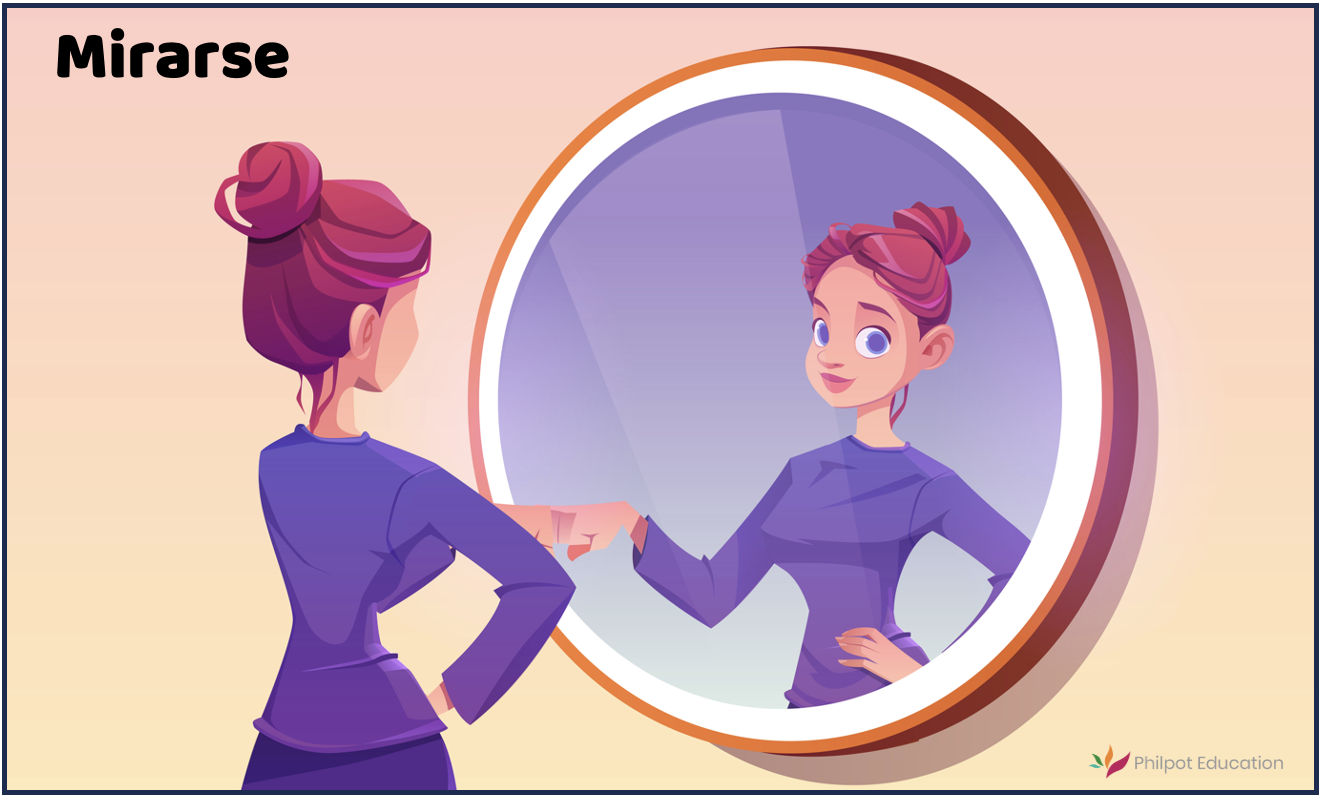
As you know, reflexive verbs are those in which the subject who performs the action of the verb is also the one who receives it, as in the following example: 'La chica se mira en el espejo' (the girl looks at herself in the mirror). In this case, we use the reflexive verb 'mirarse' (to look at oneself) because the girl is performing the action of looking and, at the same time, is observing her own image. On the other hand, in the sentence 'La chica mira el cuadro' (The girl looks at a painting), the verb 'mirar' (to look at) is non-reflexive, because the girl is observing an object (the painting), not herself.
However, there are other reflexive verbs where the meaning changes between the reflexive and non-reflexive forms. In this lesson, we will see some examples, although we won't go into detail on the topic. The goal is to provide you with an overview, which you can explore further as you progress through the course.
1. Verbos de placer
I call them 'verbos de placer' (verbs of pleasure) because they are actions that bring us satisfaction and well-being, such as eating, drinking, having, and reading, among others. When we use these verbs reflexively, we convey a deeper emotional connection with the action and, above all, with the object of the action. This object must be countable, as we refer to it in its entirety.
You’ll understand this better with an example. When I say 'bebo café' or 'tomo café' (I drink or I have coffee), I am expressing my habit of drinking coffee (the coffee is uncountable); however, when I say 'me bebo un café' or 'me tomo un café' (I drink or I have a coffee), it means that I am in the habit of drinking a full cup of coffee (the coffee is countable).
| Me como un bocadillo. | I eat a sandwich (the whole thing). |
| Me he leído "El Señor de los Anillos". | I've read "The Lord of the Rings" (from cover to cover). |
| Me eché una buena siesta. | I took a good nap (and it was very enjoyable). |
2. Verbos de cambio
Many reflexive verbs express a state of transformation or change (in characteristics, state, mood, etc.).
| Me hago mayor. | I'm getting older (a characteristic). |
| Me he puesto enfermo. | I've gotten sick (a state). |
| Me enfadé mucho. | I got very angry (a mood). |
Notice that verbs related to emotions are used reflexively, as they express internal psychological processes, such as 'sentirse' (feeling), 'enfadarse' o 'enojarse' (getting angry), 'alegrarse' (becoming happy), 'entristecerse' (getting sad), 'aburrirse' (getting bored), 'avergonzarse' (getting embarrassed), and 'preocuparse' (worrying), among others.
3. Cambios de significado
When we use the reflexive form of a verb, we nuance its meaning. In pleasure verbs and some others, the nuance is very subtle; for example, 'comer' (to eat) vs. 'comerse' (to eat up) or 'ir' (to go) vs. 'irse' (to go away). In verbs of change, the nuance is much more pronounced; for example, 'aburrir' (to bore) vs. 'aburrirse' (to get bored). Finally, in this third category, I refer to some verbs that radically change their meaning when used reflexively.
|
Quedamos a las cinco. Nos quedamos en casa. |
We agreed to meet at five. We stayed at home. |
|
Acordamos renovar el contrato. Nos acordamos mucho de la abuela. |
We agreed to renew the contract. We remember grandma a lot. |
|
Llevo una camisa verde. Me llevo bien con mi hermana. |
I wear a green shirt. I get along well with my sister. |