6. Extra: el verbo HABER

Objetivos

In this unit, you've encountered the verb haber in various ways:

  • Hay un gato en mi habitación (There is a cat in my room).
  • Hay muchas plantas en mi balcón (There are many plants in my balcony).

  • He regado las plantas (I have watered the plants).
  • ¿Has hecho tus tareas? (Have you done your chores?).

Think of the verb HABER (to have) as a road that splits into two paths. 
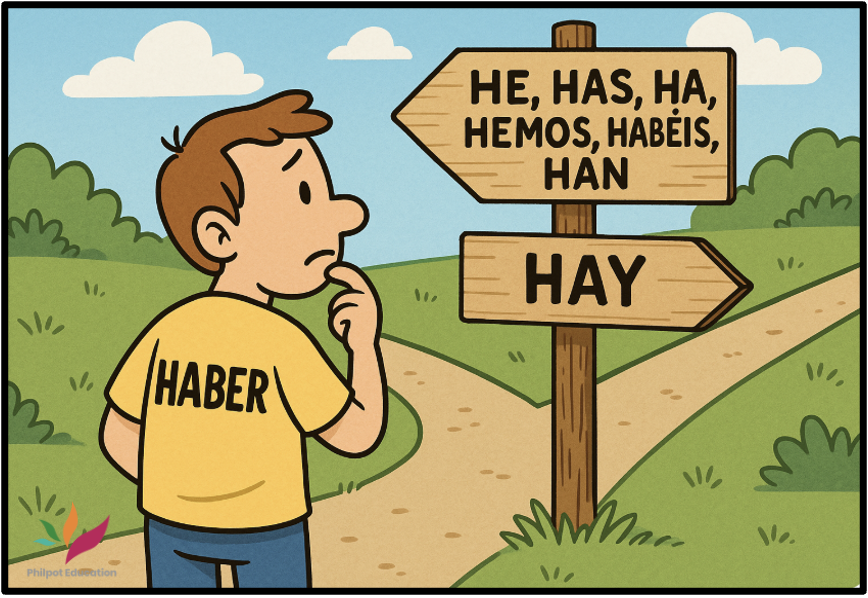
Haber

In the cartoon, you can see the forms of the verb HABER in the present tense. Click on this link to find other tenses

HAY

Yo he

has

Él/ella/usted ha

Nosotros/nosotras hemos

Vosotros/vosotras habéis

Ellos/ellas/ustedes han

  • Impersonal form: it has no subject and the verb does not change.
  • Personal form: it is conjugated (the verb changes to match the subject).
  • It is translated as there is or there are.
  • It is translated as to have.
  • It is used to speak about the existence of something or someone.
  • Example: Hay muchas plantas en el balcón (There are many plants in the balcony).
  • It is used as an auxiliary verb, mainly to form the present perfect (pretérito perfecto compuesto).
  • Example: He regado las plantas (I have watered the plants).
  • It can also be used to express obligation in a generic, non-personal way.
  • Example: Hay que regar las plantas (One has to water the plants).
  • It can also be used to express obligation in a direct, personal way.
  • Example: Has de regar las plantas (You have to water the plants). 
  • Note that this structure is quite archaic, hence only used in formal contexts. In everyday language, the verb tener is preferred: Tienes que regar las plantas.


Test your skills:

Would you be able to choose the correct path of the verb haber? Test your skills with the following interactive activity.