2. Adónde voy
4. Extra: El imperativo (año 2)
Lluvia de ideas: Los modos verbales
Brainstorm: Verb moods
En español existen tres modos verbales, que expresan la intención comunicativa del hablante: el modo indicativo, el subjuntivo y el imperativo. ¿Sabes para qué se utiliza cada uno de ellos?
In Spanish, there are three verb moods, which express the communicative intention of the speaker: the indicative, the subjunctive, and the imperative. Do you know what each of them is used for?The imperative mood is used to give orders, make suggestions, grant permission, give instructions... In its negative form, it is used to forbid. You can use other structures to achieve these goals, but the imperative is by far the most direct, persuasive and effective.
In Spanish, the imperative only has special forms for the subjects tú and vosotros, and only for positive commands. For the other subjects (usted, nosotros and ustedes) and for negative commands, we use the present subjunctive. If you need to remember or learn its forms, click on the link to jump to the relevant lesson.
To form the tú commands, remove the s from the present indicative form:
- Entrar (to enter) - Tú entras (you enter) - ¡Entra! (Enter! / Come in!)
- Comer (to eat) - Tú comes (you eat) - ¡Come! (Eat!)
- Escribir (to write) - Tú escribes (you eat) - ¡Escribe! (Write!)
To form the vosotros/as commands, replace the r from the infinitive with d:
- Entrar - ¡Entrad!
- Comer - ¡Comed!
- Escribir - ¡Escribid!
Note that the form of the second person plural (vosotros/as) is always regular in Spanish. However, if the verb is reflexive, you must remember to drop the d, as per the example:
- Niños, comed la verdura (Children, eat the vegetables).
- Niños, comeos toda la verdura (Children, eat all the vegetables).
El modo imperativo: verbos regulares
The imperative mood: regular verbs
| Positive commands | Negative commands |
|---|---|
|
Habla (tú) - Speak
Hable (usted)
Hablemos (nosotros/as) - Let's speak
Hablad (vosotros/as)
Hablen (ustedes)
|
No hables - Don't speak
No hable
No hablemos - Let's not speak
No habléis
No hablen
|
|
Come - Eat
Coma
Comamos - Let's eat
Comed
Coman
|
No comas - Don't eat
No coma
No comamos - Let's not eat
No comáis
No coman
|
|
Sube - Go up
Suba
Subamos - Let's go up
Subid
Suban
|
No subas - Don't go up
No suba
No subamos - Let's no go up
No subáis
No Suban
|
In Spanish, there are only eight verbs with special irregular forms in the affirmative imperative: decir (to say), hacer (to do or make), ir (to go), poner (to put), salir (to exit or go out), ser (to be), tener (to have), and venir (to come).
To these, we must add derived verbs: deshacer (to undo), componer (to compose), suponer (to suppose), obtener (to obtain), detener (to stop, to arrest)...
Note that the forms are only irregular in the second person singular (tú).
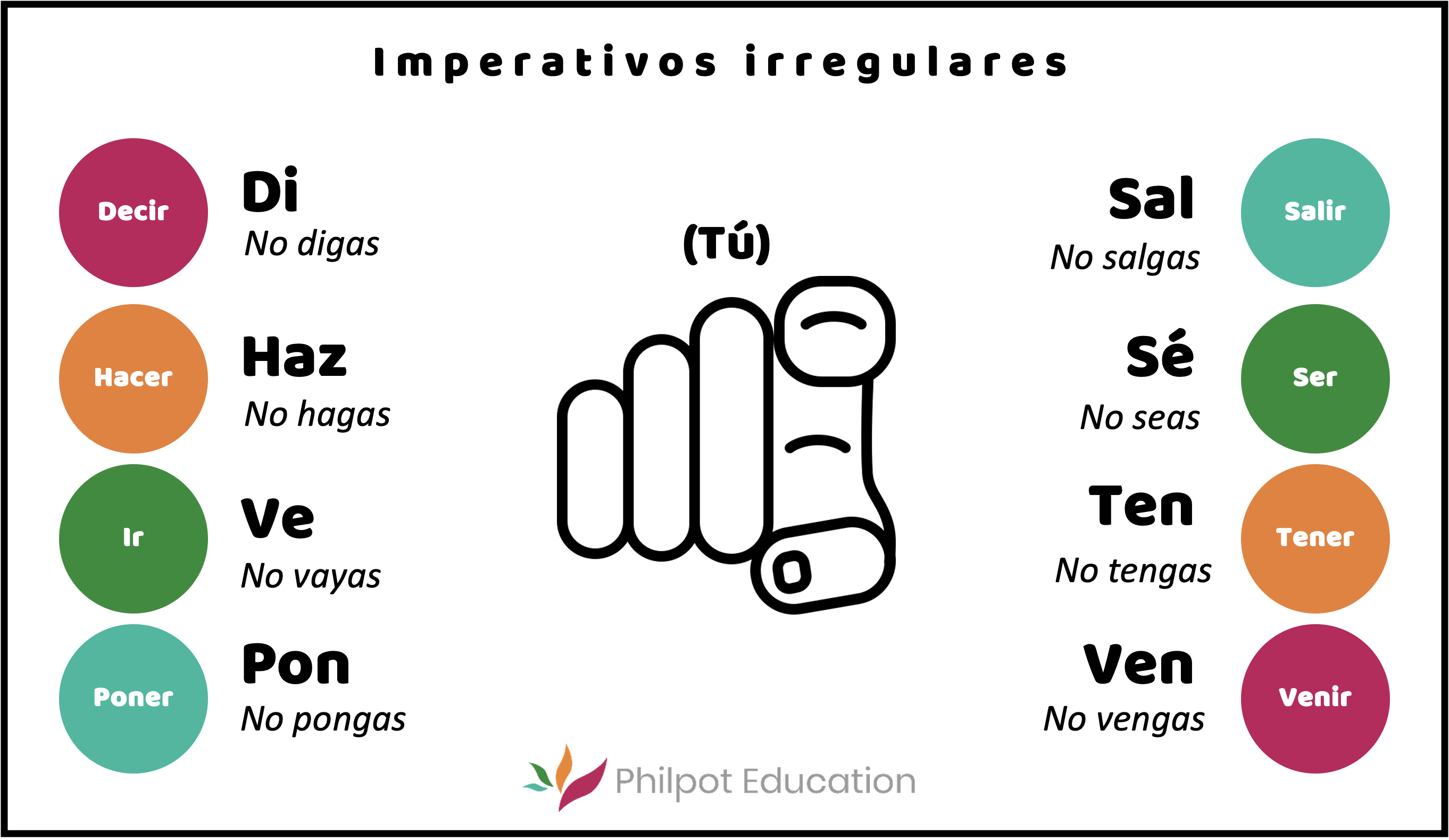
El modo imperativo: verbos irregulares
The imperative mood: irregular verbs
| Positive commands | Negative commands |
|---|---|
|
Di (tú) - Tell / Say
Diga (usted)
Digamos (nosotros/as) - Let's tell / say
Decid (vosotros/as)
Digan (ustedes)
|
No digas - Don't tell / say
No diga
No digamos - Let's not tell / say
No digáis
No digan
|
|
Haz (tú) - Do
Haga
Hagamos - Let's do
Haced
Hagan
|
No hagas - Don't do
No haga
No hagamos - Let's not do
No hagáis
No hagan
|
|
Ve (tú) - Go
Vaya
Vayamos - Let's go
Id
Vayan
|
No vayas - Don't go
No vaya
No vayamos - Let's not go
No vayáis
No vayan
|
|
Pon (tú) - Put
Ponga
Pongamos - Let's put
Poned
Pongan
|
No pongas - Don't put
No ponga
No pongamos - Let's not put
No pongáis
No pongan
|
|
Sal (tú) - Go out
Salga
Salgamos - Let's go out
Salid
Salgan
|
No salgas - Don't go out
No salga
No salgamos - Let's not go out
No salgáis
No salgan
|
|
Sé (tú) - Be
Sea
Seamos - Let's be
Sed
Sean
|
No seas - Don't be
No sea
No seamos - Let's not be
No seáis
No sean
|
|
Ten (tú) - Have
Tenga
Tengamos - Let's have
Tened
Tengan
|
No tengas - Don't have
No tenga
No tengamos - Let's not have
No tengáis
No tengan
|
|
Ven (tú) - Come
Venga
Vengamos - Let's come
Venid
Vengan
|
No vengas - Don't come
No vengaNo vengamos - Let's not come No vengáis No vengan |
In addition to the eight special irregular forms, remember that boot verbs will carry their irregularity from the indicative into the imperative mood:
- ¡Despierta! (Wake up!) from the verb despertar.
- ¡Juega! (Play!) from the verb jugar.
- ¡Vuelve! (Come back!) from the verb volver.
- ¡Pide! (Request!) from the verb pedir.
- ¡Duerme! (Sleep!) from the verb dormir.
Something very important to remember about the imperative mood is that pronouns (reflexive, indirect, and direct object pronouns) are always placed after the verb and attached to it. Note that this only applies to the second persons, singular (tú) and plural (vosotros/as), and only for positive commands.
Examples:
- ¡Cállate! (Shut up!) - Te is a reflexive pronoun from the verb callarse.
- ¡Hazlo! (Do it!) - Lo is a direct object pronoun.
- ¡Dinos la verdad! (Tell us the truth!) - Nos is an indirect object pronoun.
- ¡Dínosla! (Tell it to us!) - Here we've replaced the truth (la verdad) with the direct pronoun la. Note that the direct pronoun is always placed after the indirect pronoun (nos).
Note that when adding pronouns after the verb we must add an accent if the stress falls in the third-to-last syllable (e.g., dínosla).
Another thing to remember is: with the second person plural (vosotros/as), you must drop the d, when attaching the pronoun os:
- ¡Amaos! (Love one another!), from the verb amarse.
- ¡Poneos la chaqueta! (Put on the jacket!), from the verb ponerse.
- ¡Divertíos! (Have fun!), from the verb divertirse. Note that you must add an accent on the i.
Similarly, when adding nos to the first person plural (nosotros/as), the s is dropped. Note that an accent must be added as well:
- ¡Calmémonos! (Let's calm down!), from the verb calmarse.
- ¡Querámonos! (Let's love each other!), from the verb quererse.
- ¡Durmámonos! (Let's fall asleep!), from the verb dormirse.
El modo imperativo: verbos reflexivos
The imperative mood: reflexive verbs
| Positive commands | Negative commands |
|---|---|
|
Levántate (tú) - Get up!
Levántese (usted)
Levantémonos - Let's get up!
Levantaos (vosotros/as)
Levántense (ustedes)
|
No te levantes - Don't get up!
No se levante
No nos levantemos - Let's not get up!
No os levantéis
No se levanten
|
|
Ponte - Put on!
Póngase
Pongámonos - Let's put on!
Poneos
Pónganse
|
No te pongas - Don't put on!
No se ponga
No nos pongamos - Let's not put on!
No os pongáis
No se pongan
|
|
Vístete - Get dressed!
Vístase
Vistámonos - Let's get dressed!
Vestíos
Vístanse
|
No te vistas - Don't get dressed!
No se vista
No nos vistamos - Let's not get dressed!
No os vistáis
No se vistan
|
This video by ProfeDeEle summarizes everything you need to know about the imperative mood in Spanish, in a clear and dynamic way.
Click on the links to practice the imperative forms with Conjuguemos:
Test your skills: