1. El tiempo
3. El tiempo y yo
Actividad de calentamiento: Mira por la ventana
Warm-up activity: Look out the window
Comenta las imágenes: / Comment the images:
- ¿Qué ves? (What do you see?)
- ¿Qué tiempo hace? (How's the weather like?)
- ¿Qué estación crees que es? (What season do you think it is?)
- ¿Cómo te hace sentir cada imagen? (How does each image make you feel?)
- ¿Cómo te afecta el tiempo? (How does the weather affect you?)
- ¿Qué tiempo prefieres? (What weather do you prefer?)
Haz clic en los iconos interactivos para leer algunos ejemplos. / Click on the interactive icons to read some examples.
Sin duda, el tiempo ejerce una gran influencia en nuestras vidas. Afecta a nuestro estado de ánimo y a nuestros deseos. Todas las pequeñas decisiones de nuestro día a día están condicionadas por el tiempo: qué ropa nos ponemos, qué comemos, qué hacemos, adónde vamos y cómo nos desplazamos. En esta lección, vamos a aprender vocabulario y estructuras que nos ayuden a expresar y desarrollar estas ideas.
Without a doubt, the weather has a great influence on our lives. It affects our mood and our desires. All the small decisions in our daily lives are shaped by the weather: what clothes we wear, what we eat, what we do, where we go, and how we get there. In this lesson, we are going to learn vocabulary and structures that will help us express and develop these ideas.
¿Cómo te sientes cuando hace sol? ¿Y cuando hace mal tiempo?
Si has respondido feliz o triste, está bien, pero puedes enriquecer tu vocabulario para describir un abanico más amplio de emociones. En esta infografía encontrarás algunos ejemplos.
How do you feel when it’s sunny? And when the weather is bad?
If you answered happy or sad, that’s fine, but you can enrich your vocabulary to describe a wider range of emotions. In this infographic, you will find some examples.
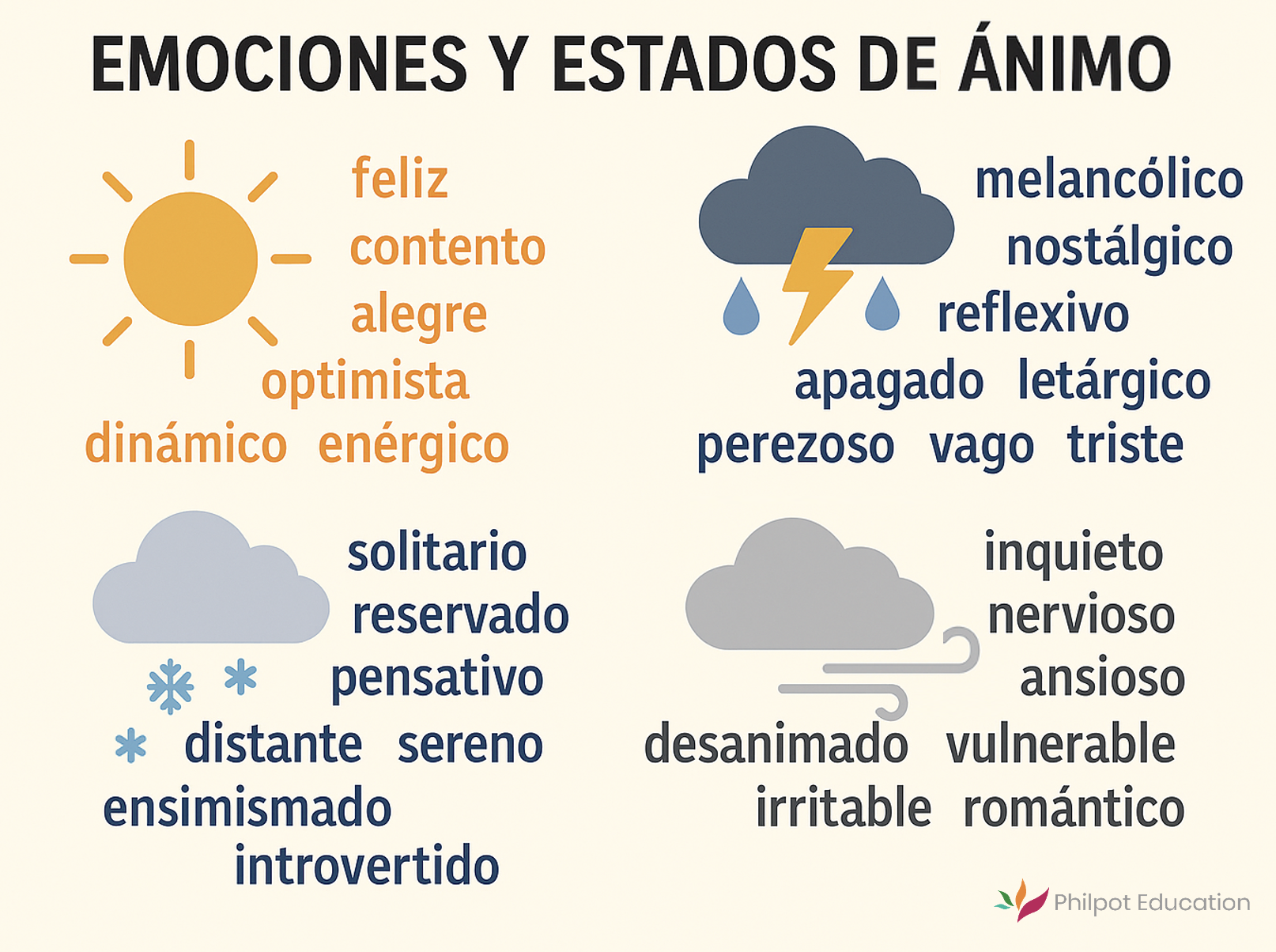
Expresar emociones con adjetivos
Expressing emotions with adjectives
To express how we feel, we use the verb estar (to be). You may also use other verbs such as sentirse (to feel) or ponerse (to become).
|
Español
|
Inglés
|
|---|---|
|
Cuando hace sol, estoy feliz.
|
When the weather is good, I'm happy.
|
| Cuando llueve, me siento serena. |
When it rains, I feel serene.
|
| Cuando nieva, me pongo romántica. |
When it snows, I get romantic.
|
You can also invert the structure and say that the weather makes you feel a certain way, using the verbs poner (to put), volver (to turn), hacer (to make).
|
Español
|
Inglés
|
|---|---|
|
El calor me pone nerviosa.
|
Hot weather makes me nervous.
|
| El verano me vuelve loca. | Summer drives me crazy. |
| El otoño me hace sentir nostálgica. | Autumn makes me feel nostalgic. |
Note that in the examples above, I used the adjectives in the feminine form because I, the speaker, am a woman. Remember that in Spanish, adjectives must agree in gender and number with the noun they describe.
Descarga la hoja de trabajo y contesta a las preguntas: ¿Cómo te impactan las estaciones y el tiempo? / Download the worksheet and answer the questions: How do the seasons and the weather affect you?
Hoja de trabajo: ¿Cómo te impactan las estaciones y el tiempo?
Actividad en pareja: Habla
Pair activity: Speak
En pareja, comentad cómo las estaciones y el tiempo afectan vuestro estado de ánimo. ¿Estáis de acuerdo? Utiliza las estructuras de la tabla para expresar acuerdo y desacuerdo.
In pairs, discuss how the seasons and the weather affect your mood. Do you agree? Use the table's structures to express agreement and disagreement.
|
Español
|
Inglés
|
|---|---|
|
- Me encanta el verano, ¿y a ti?
- A mí también. / Pues a mí, no.
|
- I love the summer, what about you?
- Me too. / I don't.
|
|
- El verano me hace feliz, ¿y a ti?
- A mí también. / Pues a mí, no.
|
- Summer makes me happy. And you? - Me too. / I don't. |
|
- No me gusta nada el frío, ¿y a ti?
- A mí tampoco. / Pues a mí, sí.
|
- I don't like the cold at all, and you?
- Me neither. / I do.
|
|
- Cuando llueve, me siento feliz. ¿Y tú?
- Yo también. / Pues yo no.
|
- When it rains, I feel happy. And you?
- Me too. / I don't.
|
|
- Cuando hace calor, me pongo nerviosa. ¿Y tú?
- Yo también. / Pues yo no.
|
- When it is hot, I get nervous. And you?
- Me too. / I don't
|
El tiempo influye en una infinidad de decisiones de tu vida cotidiana: desde la ropa que eliges ponerte hasta el lugar adonde decides ir, pasando por lo que vas a comer. Antes de responder a las preguntas de la hoja de trabajo, repasa el vocabulario con las siguientes actividades interactivas.
The weather influences countless decisions in your daily life: from the clothes you choose to wear to the places you decide to go, including what you are going to eat. Before answering the questions on the worksheet, review the vocabulary with the following interactive activities.
¿Qué me pongo?
¿Qué me tomo?
¿Qué hago?
Descarga la hoja de trabajo y contesta a las preguntas: ¿Qué haces según el tiempo? / Download the worksheet and answer the questions: What do you do depending on the weather?
Hoja de trabajo: ¿Qué haces según el tiempo?
Actividad en pareja: Habla
Pair activity: Speak
En parejas, comentad cómo influye el tiempo en lo que hacéis. ¿Estáis de acuerdo? Utiliza las estructuras de la tabla para expresar acuerdo y desacuerdo.
In pairs, discuss how the weather influences what you do. Do you agree? Use the table's structures to express agreement and disagreement.
|
Español
|
Inglés
|
|---|---|
|
- Cuando hace sol, me gusta pasear. ¿Y a ti?
- A mí también. / Pues a mí, no.
|
- When it is sunny, I like to walk. What about you?
- Me too. / I don't.
|
|
- Cuando llueve, prefiero quedarme en casa. ¿Y tú?
- Yo también. / Pues yo no.
|
- When it rains, I prefer to stay home. And you? - Me too. / I don't. |
|
- Cuando hace calor, no me gusta salir. ¿Y a ti?
- A mí tampoco. / Pues a mí, sí.
|
- When it is hot, I don't like to go out. What about you?
- Me neither. / I do.
|
|
- Cuando hace frío, no salgo de casa. ¿Y tú?
- Yo tampoco. / Pues yo sí.
|
- When it is cold, I don't leave home. And you?
- Me neither. / I do.
|
Al hacer planes, usamos el futuro perifrástico (ir a + infinitivo) cuando estamos seguros de lo que queremos hacer. Sin embargo, incluso los planes más firmes a veces se vienen abajo. En este vídeo de Tío Spanish, observa cómo cambian sus planes según el tiempo. Toma nota del vocabulario nuevo y de las expresiones y estructuras avanzadas. Descarga la transcripción para tomar notas.
When making plans, we use the periphrastic future (ir a + infinitive) when we are sure about what we want to do. However, even the firmest plans sometimes fall through. In this Tío Spanish video, observe how his plans change depending on the weather. Take note of the new vocabulary and the advanced expressions and structures. Download the transcript to take notes.
Descarga: Transcripción del vídeo de Tío Spanish
Expresar condiciones posibles
Expressing possible conditions
Our plans are often conditioned by the weather. To express possible conditions, we use the conjunction si (if) + the condition with the verb in the present tense + the consequence or result with the verb in the simple future. Take a look at the examples.
|
Español
|
Inglés
|
|---|---|
|
Si hace sol, haremos un picnic.
|
If it's sunny, we'll have a picnic.
|
| Si llueve, iremos al restaurante. |
If it rains, we'll go to a restaurant.
|
| Si hay tormenta, me quedaré en casa. |
If there is a storm, I will stay home.
|
If you need to revise the simple future forms (futuro imperfecto), rewatch this video from Cursos Ele.
Expresar deseos (año 2)
Expressing wishes (year 2)
In Spanish, wishes are expressed in the subjunctive mood. Take a look at the examples.|
Español
|
Inglés
|
|---|---|
|
Espero que el día salga bueno.
|
I hope the day turns out nice.
|
| ¡Ojalá (que) haga sol! |
I hope it is sunny!
|
| Rezo para que no llueva. |
I pray that it won't rain.
|
Listen to this song by Juan Luis Guerra. What is he wishing for?
Actividad en pareja: Escribe
Pair activity: Write
En parejas, imaginad que estáis organizando una escapada de fin de semana a una ciudad hispanohablante. Escribid un diálogo en forma de mensajes de texto en un Google Doc compartido, como si fuera una app de chat. Pensad en distintos planes según el tiempo. El objetivo es usar el vocabulario y las expresiones relacionadas con el tiempo, así como estructuras avanzadas: condiciones, intenciones y deseos.
In pairs, imagine you are planning a weekend getaway to a Spanish-speaking city. Write a dialogue in the form of text messages in a shared Google Doc, as if it were a chat app. Think of different plans depending on the weather. The goal is to use weather-related vocabulary and expressions, as well as advanced structures: conditions, intentions, and wishes.
Enlace cultural: Refranes y dichos populares
Cultural link: Popular proverbs and sayings
El tiempo no solo nos afecta a nivel personal, sino que también influye en nuestra cultura. Fíjate en los siguientes dichos del refranero español, que muestran lo estrechamente conectados que están el clima, la agricultura y las emociones en la cultura española. ¿Qué crees que significan? Para comprobar si tus hipótesis son correctas, descarga las explicaciones haciendo clic en el enlace.The weather not only affects us on a personal level, but it also influences our culture. Look at the following sayings from the Spanish repertoire of proverbs, that show how closely weather, agriculture, and emotions are connected in Spanish culture. What do you think they mean? To check if your guesses are correct, download the explanations by clicking on the link.
- En abril, aguas mil (In April, a thousand waters.)
- Hasta el cuarenta de mayo, no te quites el sayo (Until the fortieth of May, don’t take off your cloak.)
- Cuando marzo mayea, mayo marcea (When March behaves like May, May behaves like March.)
- Agua de mayo, pan para todo el año (Water of May, bread for the whole year.)
- Esperar algo como agua de mayo (Waiting for something like water of May.)
- Año de nieves, año de bienes (Year of snows, year of goods.)
- La primavera, la sangre altera (Spring stirs the blood.)
- A mal tiempo, buena cara (To bad weather, a good face.)
De Profe a Profe:
Fuente: Nachter
Para terminar la lección (o empezarla) con una nota de humor, puedes enseñarles a tus alumnos este Short de Nachter, conocido YouTuber español. Aunque España goza de un clima bastante bueno, los españoles nos quejamos del tiempo (y de muchas otras cosas) durante todo el año...
Imprime la transcripción, con preguntas y actividades de aprovechamiento, para que tus alumnos reflexionen y aprendan las estructuras más útiles para expresar quejas y emociones intensas.