1. El tiempo
5. Los tiempos verbales (año 2)
Ya sabes que la palabra "tiempo" tiene varias traducciones al inglés: "time", "weather" y "tense". En esta lección, nos vamos a centrar en los tiempos verbales. Mira este vídeo de Easy Spanish. Varias personas son entrevistadas sobre el tiempo. Fíjate en los tiempos verbales y en el vocabulario.
You already know that the word “tiempo” has several translations in English: “time,” “weather,” and “tense.” In this lesson, we’re going to focus on verb tenses. Watch this Easy Spanish video. Several people are interviewed about the weather. Pay attention to the verb tenses and the vocabulary.
Después de ver el vídeo, decide a qué pregunta corresponde cada respuesta.
After watching the video, decide which question each answer corresponds to.
Hemos escuchado una gran variedad de tiempos verbales en las respuestas a estas cuatro preguntas. Para profundizar en el tema, vamos a analizar algunos ejemplos.
We’ve heard a wide variety of verb tenses in the answers to these four questions. To explore the topic further, let’s analyze some examples.
¿Qué tiempo hace hoy? Para contestar a esta pregunta, algunas personas han utilizado el presente y otras, el pretérito perfecto compuesto.
What’s the weather like today? To answer this question, some people have used the present tense and others, the present perfect.
| Presente | Present | |
|---|---|---|
| Hoy hace un día soleado. | Today is a sunny day. | |
| Hoy hace muy buen tiempo. | Today the weather is really nice. | |
| El cielo está bastante claro y azul. | The sky is quite clear and blue. | |
| Es un día bastante fresquito. | It’s a rather cool day. | |
| No hace nada de calor. | It’s not hot at all. |
Usamos el presente para describir el tiempo que hace en este momento, pero también para hablar del clima en general hoy en día. En cambio, usamos el pretérito perfecto compuesto para hablar de un hecho ya terminado, pero ocurrido en un periodo de tiempo que sigue conectado con el presente (por ejemplo: esta mañana, esta tarde, hoy…).
We use the present tense to describe the weather at this moment, but also to talk about the climate in general nowadays. In contrast, we use the present perfect to talk about an action that has already finished but took place within a time period still connected to the present (for example: this morning, this afternoon, today…).
| Pretérito perfecto compuesto | Present perfect | |
|---|---|---|
| Hoy ha salido un día muy soleado. | It’s been a very sunny day today. | |
| Por la mañana ha hecho bastante bochorno. | In the morning, it’s been quite muggy. | |
| Ha hecho bastante calor. | It’s been quite hot. |
Fíjate en la conjugación de los principales verbos relacionados con el tiempo.
Pay attention to the conjugation of the main weather-related verbs.
| Presente | Pretérito perfecto compuesto |
|---|---|
| Hace mal tiempo. | Ha hecho mal tiempo. |
| Hay tormentas. | Ha habido tormentas. |
| Llueve. | Ha llovido. |
| Está lloviendo. | Ha estado lloviendo. |
| Nieva. | Ha nevado. |
Test your skills
Transform the verbs from present to present perfect.
Ejemplo:
Por la mañana sale el sol. Esta mañana ha salido el sol.
¿Qué tiempo hizo el fin de semana pasado? Para responder a esta pregunta sobre un periodo pasado ya concluido, lo habitual es usar el pretérito perfecto simple. Sin embargo, uno de los entrevistados responde con el pretérito perfecto compuesto. ¿Por qué? ¿Crees que está mal?
What was the weather like last weekend? To answer this question about a past period that has already ended, it’s usual to use the preterite tense. However, one of the interviewees answers using the present perfect. Why? Do you think that’s wrong?
| Pretérito perfecto simple | Simple past | |
|---|---|---|
| Hizo bastante bueno. | The weather was quite nice. | |
| Hizo calor. | It was hot. | |
| Pretérito perfecto compuesto | Present perfect | |
| Hemos tenido algunos días con mucho calor. | We've had a few very hot days. |
Desde un punto de vista estrictamente gramatical, el tiempo correcto sería el pretérito perfecto simple. Sin embargo, en el uso real de la lengua, prevalece la intención comunicativa sobre las normas gramaticales. En este caso, el hablante percibe esos días calurosos como muy recientes y siente que sus efectos todavía están presentes. Esa vinculación emocional con el presente hace que no resulte incorrecto emplear el pretérito perfecto compuesto al referirse al fin de semana pasado.
From a strictly grammatical point of view, the correct tense would be the preterite. However, in actual language use, communicative intent takes precedence over grammatical rules. In this case, the speaker perceives those hot days as very recent and feels that their effects are still present. This emotional connection to the present makes it not incorrect to use the present perfect when referring to last weekend.
| Pretérito perfecto compuesto | Pretérito perfecto simple |
|---|---|
| Ha hecho mucho calor. | Hizo mucho calor. |
| Ha habido picos de calor. | Hubo picos de calor. |
| Ha llovido un poco. | Llovió un poco. |
| Ha estado lloviendo. | Estuvo lloviendo. |
| Ha nevado. | Nevó. |
Test your skills
Transform the verbs from present perfect to simple past.
Ejemplo:
Esta noche ha llovido. Anoche llovió.
¿Ha cambiado mucho el clima a lo largo del tiempo? Para responder a esta pregunta, algunos entrevistados han usado el pretérito perfecto compuesto para hablar de cambios climáticos que comenzaron en el pasado y cuyos efectos se siguen notando hoy en día. En cambio, para hablar de cómo era el clima normalmente en el pasado, en sus recuerdos, utilizan el pretérito imperfecto. ¿Sabrías explicar qué otros usos tiene el pretérito imperfecto?
Has the climate changed much over time? To answer this question, some interviewees have used the present perfect to talk about climate changes that began in the past and whose effects can still be felt today. In contrast, to talk about what the weather was normally like in the past—in their memories—they use the imperfect tense. Could you explain what other uses the imperfect tense has?
| Pretérito perfecto compuesto | Present perfect | |
|---|---|---|
| El clima ha cambiado muchísimo. | The climate has changed a lot. | |
| Hemos tenido épocas de muchísimo calor, que no es normal aquí. | We’ve had periods of extreme heat, which isn’t normal here. | |
| Pretérito imperfecto | Imperfect past | |
| Antiguamente, cuando mi padre era joven, nevaba. | In the past, when my father was young, it used to snow. | |
| Había capas (de nieve) de metro y medio de altura. | There were layers (of snow) a meter and a half high. | |
| Antes llovía más a menudo. | It used to rain more often. | |
| Antes quizás había un tiempo más estable. | Perhaps in the past the weather was more stable. |
El pretérito imperfecto se utiliza para:
- Describir rutinas o situaciones habituales del pasado (por ejemplo: “Antes no hacía tanto calor como ahora.”)
- Describir una acción en desarrollo en un momento pasado; en el presente, la acción está terminada, pero en el momento pasado en el que se sitúa nuestro discurso todavía se estaba desarrollando (por ejemplo: “Cuando llegué a Bilbao, estaba lloviendo.”)
- Añadir detalles descriptivos a una narración, que ayudan a ambientar la escena, pero no son indispensables para contar la historia (por ejemplo: “Fuimos a dar un paseo por la ciudad. Hacía sol y la temperatura era muy agradable.”)
The imperfect tense is used to:
- Describe past routines or habitual situations (for example: “It didn’t use to be as hot as it is now.”)
- Describe an action in progress at a past moment; in the present, the action is finished, but at the past moment when our narration takes place, it was still ongoing (for example: “When I arrived in Bilbao, it was raining.”)
- Add descriptive details to a narration, which help set the scene but are not essential to tell the story (for example: “We went for a walk around the city. It was sunny and the temperature was very pleasant.”)
| Pretérito perfecto compuesto | Pretérito perfecto simple |
|---|---|
| Ha hecho muy mal tiempo. | Hacía muy mal tiempo. |
| Ha habido precipitaciones. | Había precipitaciones. |
| Ha llovido mucho. | Llovía mucho. |
| Ha estado lloviendo. | Estaba lloviendo. |
| Ha nevado. | Nevaba. |
Test your skills
Transform the verbs from present perfect to imperfect past.
Ejemplo:
Últimamente ha hecho mucho calor. Antiguamente no hacía tanto calor.
¿Qué tiempo hará mañana? Para responder a esta pregunta, algunos entrevistados han usado el futuro perifrástico (ir a + infinitivo), mientras que otros han empleado el futuro simple. En tu opinión, ¿existe alguna diferencia?
What will the weather be like tomorrow? To answer this question, some interviewees have used the periphrastic future (ir a + infinitive), while others have used the simple future. In your opinion, is there any difference?
| Futuro perifrástico | Periphrastic future | |
|---|---|---|
| Mañana va a hacer más sol y más calor. | Tomorrow it’s going to be sunnier and hotter. | |
| Futuro imperfecto | Simple future | |
| Creo que seguirá bien, igual que hoy. | I think it will stay nice, just like today. | |
| Habrá un pico de calor. | There will be a peak of heat. |
En general, cuando hacemos previsiones meteorológicas, solemos emplear el futuro imperfecto. Este tiempo se usa normalmente para expresar conjeturas o suposiciones. También es correcto utilizar el futuro perifrástico, aunque en ese caso el mensaje transmite mayor certeza o seguridad.
In general, when we make weather forecasts, we usually use the simple future. This tense is normally used to express conjectures or assumptions. It’s also correct to use the periphrastic future, although in that case the message conveys greater certainty or confidence.
| Futuro perifrástico | Futuro imperfecto |
|---|---|
| Va a hacer malo. | Hará malo. |
| Va a haber precipitaciones. | Habrá precipitaciones. |
| Va a llover toda la semana. | Lloverá toda la semana. |
| Va a seguir lloviendo mañana. | Seguirá lloviendo mañana. |
| Va a nevar. | Nevará. |
Test your skills
Transform the verbs from periphrastic future to simple future.
Ejemplo:
Mañana va a hacer aún más calor. Mañana hará aún más calor que hoy.
¿Qué tiempo hará mañana? En lugar de responder a la pregunta, algunos de los entrevistados expresan qué tiempo desean para mañana. Para predecir el tiempo, usamos el futuro simple. En cambio, para expresar un deseo referido al futuro, usamos el presente de subjuntivo. ¿Sabes por qué?
What will the weather be like tomorrow? Instead of answering the question, some of the interviewees express what weather they would like for tomorrow. To predict the weather, we use the simple future. In contrast, to express a wish referring to the future, we use the present subjunctive. Do you know why?
| Futuro imperfecto | Simple future |
|---|---|
| Yo creo que seguirá bien. | I think it will be nice. |
| Imagino que estará como hoy. | I imagine it will be like today. |
| Presente de subjuntivo | Present subjunctive |
| Espero que siga bien. | I hope it stays nice. |
| Que siga igual y que haga buen tiempo para poder pasear. | (I hope) that it stays the same and that the weather is good so we can go for a walk. |
Cuando usamos un tiempo del modo indicativo, nuestra intención comunicativa es declarar algo como cierto. Al formular un deseo, utilizamos el subjuntivo porque nuestra intención no es afirmar su cumplimiento. Por ejemplo, al decir que deseamos que haga buen tiempo, expresamos el deseo, no afirmamos que el tiempo vaya a ser bueno.
When we use a tense in the indicative mood, our communicative intention is to state something as true. When we express a wish, we use the subjunctive because our intention is not to assert its fulfillment. For example, when we say that we wish for good weather, we are expressing the wish, not asserting that the weather will be good.
| Futuro imperfecto | Presente de subjuntivo |
|---|---|
| Hará un día soleado mañana. | Espero que haga sol mañana. |
| Habrá pocas nubes. | ¡Ojalá que haya pocas nubes! |
| Lloverá en el campo. | ¡Que llueva en el campo! |
| Seguirá haciendo fresquito. | Espero que siga haciendo fresquito. |
| Nevará estas navidades. | ¡Ojalá nieve estas navidades! |
Test your skills
Transform the verbs from simple future to present subjunctive.
Ejemplo:
Mañana hará bueno. Espero que mañana haga buen tiempo.
Actividad en parejas: Hablemos del tiempo
Pair activity: Let's talk about the weather
- Escribe tus respuestas a las preguntas del vídeo:
- ¿Qué tal el clima el día de hoy? (En el español de España: ¿Qué tiempo hace hoy?).
- ¿Y qué tal el fin de semana pasado? (¿Qué tiempo hizo el fin de semana pasado?)
- ¿Y mañana cómo estará? (¿Qué tiempo hará mañana?)
- ¿Qué clima prefieres? (¿Qué tiempo prefieres?)
- ¿Ha cambiado mucho el clima a lo largo del tiempo?
- ¿Qué tiempo
- Después, con un compañero/a, haceos mútuamente la entrevista sobre el tiempo.
- Write your answers to the questions from the video:
- What’s the weather like today?
- And how was last weekend?
- And what will it be like tomorrow?
- What weather do you prefer?
- Has the climate changed much over time?
- Then, with a partner, interview each other about the weather.
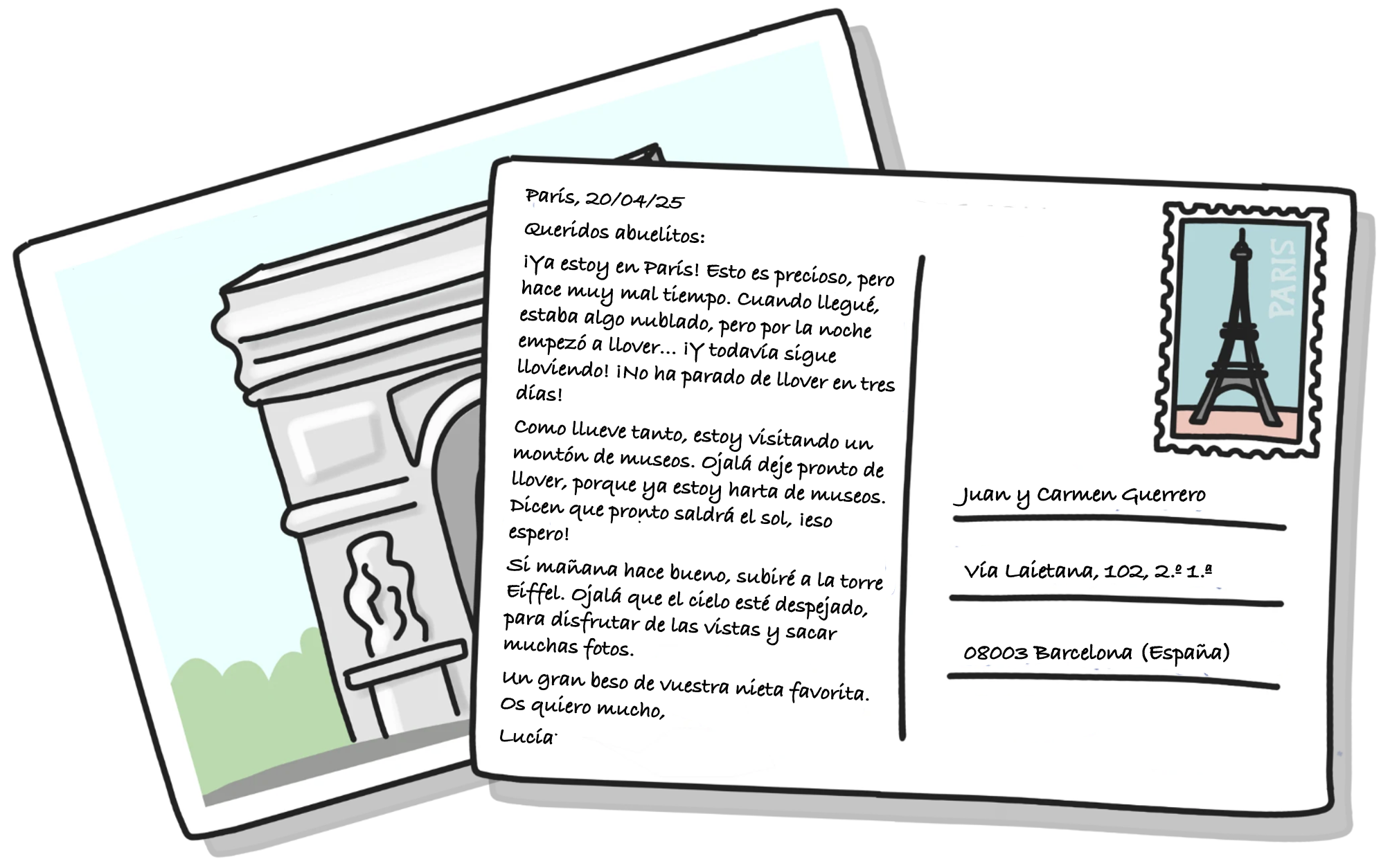
A menudo, cuando viajamos durante las vacaciones, hablamos del tiempo al enviar noticias a nuestros familiares o amigos que se han quedado en casa. Fíjate en el texto de esta postal: ¿cuántos tiempos verbales puedes identificar? Descarga la hoja de trabajo.
Often, when we travel during the holidays, we talk about the weather when sending news to our family or friends who stayed at home. Take a look at the text of this postcard: how many verb tenses can you identify? Download the worksheet.