1. El tiempo
4. La previsión del tiempo (año 2)
Lluvia de ideas: Repaso
Brainstorm: Revision
¿Recuerdas las expresiones idiomáticas españolas para hablar del tiempo? Aquí tienes una imagen de AEMET (Agencia Estatal de Meteorología) mostrando cómo está el tiempo hoy en España. ¿Sabrías describir qué tiempo hace?
- En el norte / el sur...
- En el oeste / el este...
- En el noroeste / el suroeste...
- En el noreste / el sureste...
- En el centro...
- En las islas...
- En la mayor parte del país...
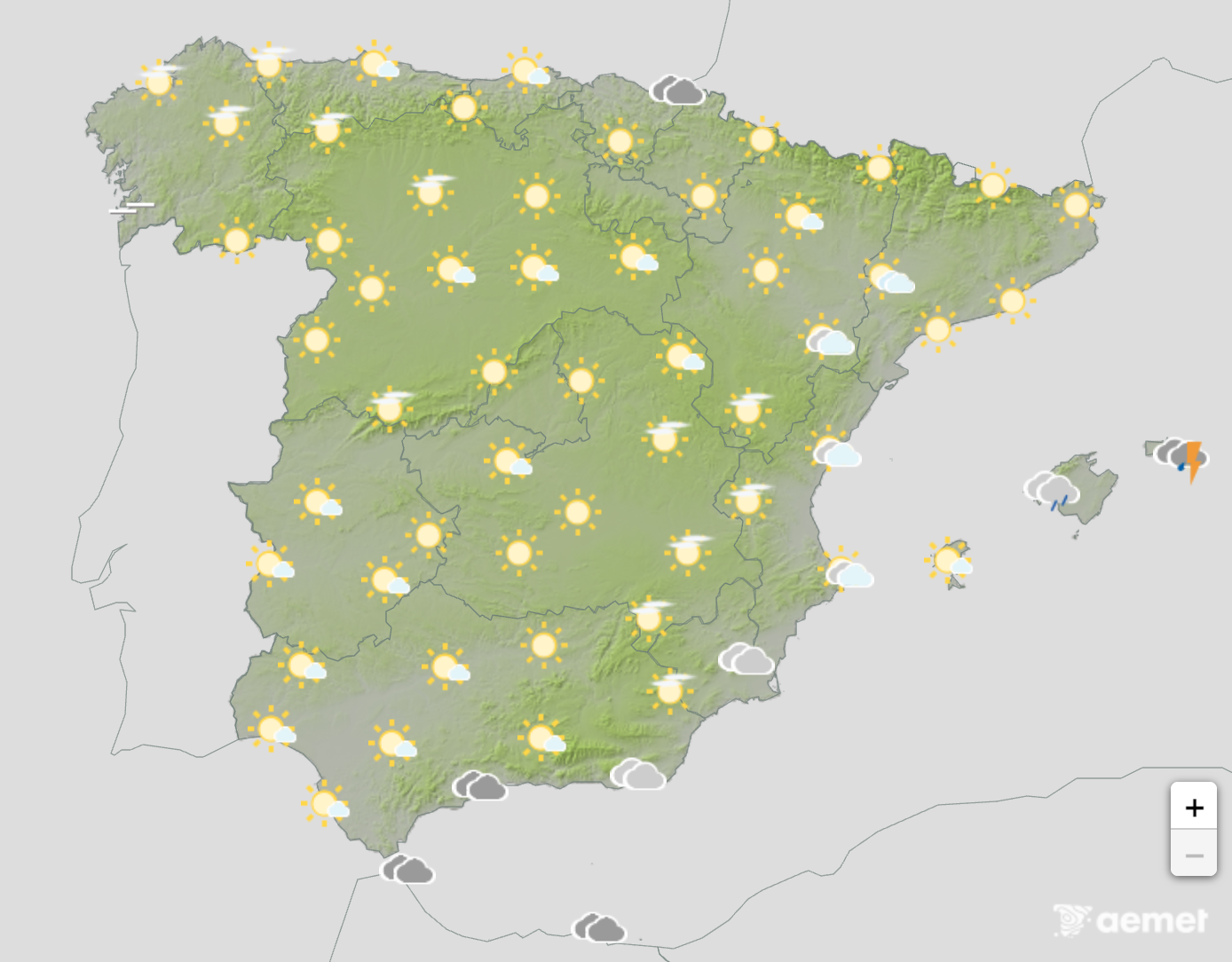
Do you remember the Spanish idiomatic expressions to talk about the weather?
Here is an image from AEMET (the Spanish State Meteorological Agency) showing what the weather is like in Spain today. Would you know how to describe what the weather is like?
- In the north / the south...
- In the west / the east...
- In the northwest / the southwest...
- In the northeast / the southeast...
- In the centre...
- In the islands...
- In most of the country...
Enlace cultural: La AEMET
Cultural link: AEMET
AEMET es la Agencia Estatal de Meteorología de España. Su función es vigilar y predecir las condiciones atmosféricas para proteger la seguridad de las personas y sus bienes. La agencia se encarga de emitir las predicciones o previsiones del tiempo, así como los avisos o alertas en situaciones de riesgo, peligro o emergencia. También realiza estudios e investigaciones para conocer mejor y asesorar sobre el cambio climático.
AEMET is the Spanish State Meteorological Agency. Its function is to monitor and forecast atmospheric conditions in order to protect the safety of people and their property. The agency is responsible for issuing weather forecasts as well as warnings or alerts in situations of risk, danger, or emergency. It also conducts studies and research to gain a better understanding of and provide advice on climate change.
Cuando la AEMET emite sus previsiones meteorológicas, a menudo utiliza un lenguaje más técnico que el que usamos en la vida cotidiana para hablar del tiempo. Fíjate en el parte o informe de la agencia correspondiente al mapa que acabas de describir y observa las expresiones y el vocabulario nuevos: se prevé(n), cielos nubosos, chubascos, precipitaciones…
When AEMET issues its weather forecasts, it often uses more technical language than what we use in everyday life to talk about the weather. Look at the bulletin or report from the agency corresponding to the map you’ve just described, and notice the new expressions and vocabulary: se prevé(n) (is/are forecast), cielos nubosos (cloudy skies), chubascos (showers), precipitaciones (precipitation/rainfall)…
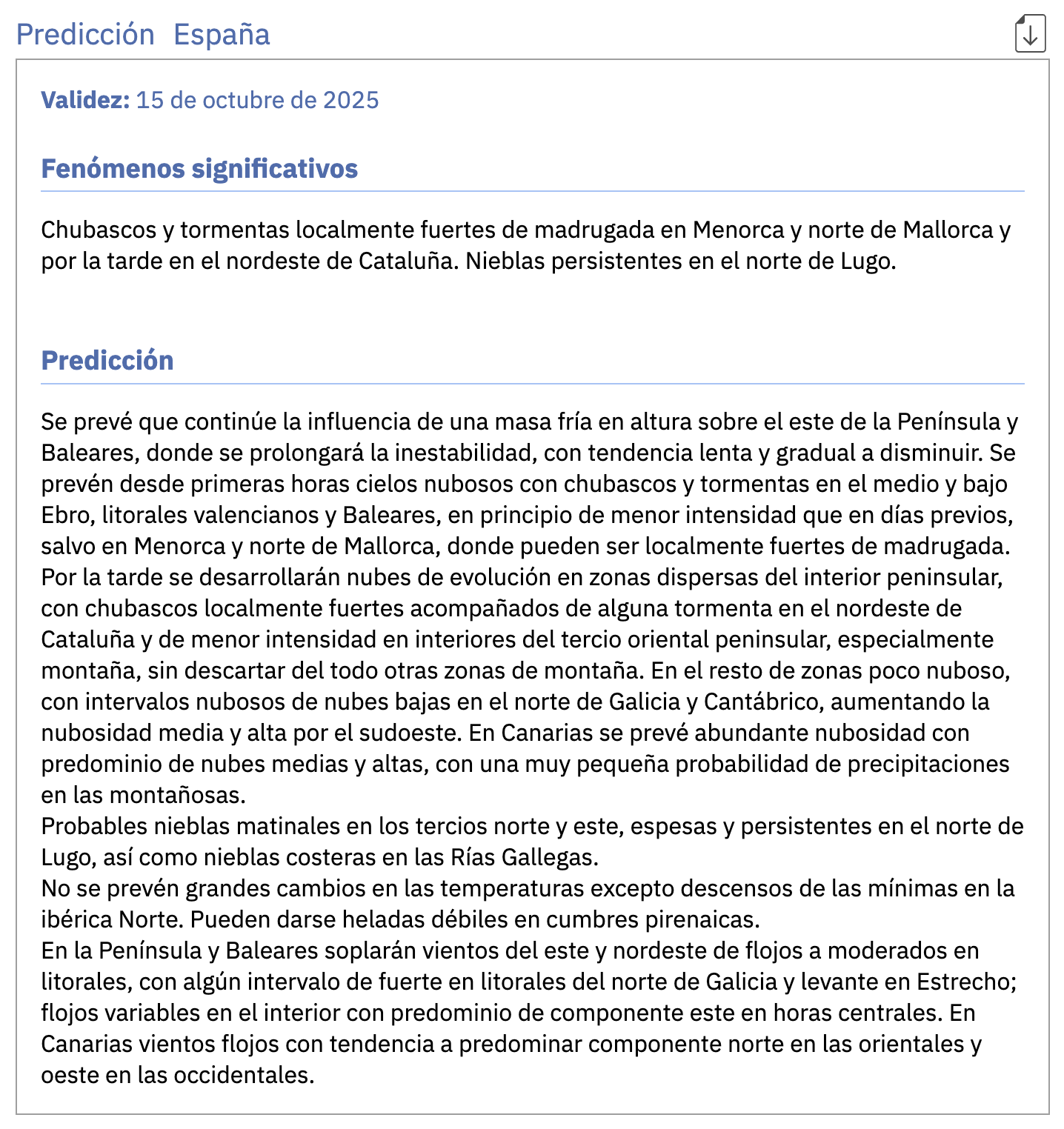
Para familiarizarte con este vocabulario más formal, que podrás usar en contextos profesionales, descarga la actividad. Puedes hacerla solo/a, en pareja o en equipo. Después, practica con la actividad interactiva.
To get familiar with this more formal vocabulary, which you can use in professional contexts, download the activity. You can do it on your own, in pairs, or in a group. Afterwards, practice with the interactive activity.
Hoja de trabajo: Léxico meteorológico
El futuro imperfecto
Simple future tense
To forecast the weather, we often use the simple future tense (futuro simple) in Spanish. This tense is mainly used to make predictions or assumptions. Below, you’ll find the main weather-related verbs conjugated in the simple future tense.| Español | Inglés |
|---|---|
|
Hará calor / frío / fresco... |
The weather will be hot / cold / cool... |
|
El cielo estará despejado / nublado / cubierto... |
The sky will be clear / cloudy / overcast... |
|
Habrá tormentas / ráfagas de viento / niebla... |
There will be storms / wind gusts / fog... |
|
Soplará el viento. Lloverá. Granizará. Nevará. |
The wind will blow. It will rain. It will hail. It will snow. |
Actividad grupal: El tiempo está loco
Group activity: The weather is crazy
- Preparad los dados del tiempo con las plantillas descargables.
- Tirad los tres dados para elaborar la predicción detallada del tiempo de mañana (por la mañana, por la tarde y por la noche).
- Tirad de nuevo los tres dados para obtener la predicción del tiempo de los próximos tres días.
- Escribid la información de manera profesional, siguiendo el modelo del parte de la AEMET.
- Prepare the weather dice using the downloadable templates.
- Roll the three dice to create a detailed weather forecast for tomorrow (in the morning, afternoon, and evening).
- Roll the three dice again to make the weather forecast for the next three days.
- Write the information in a professional way, following the AEMET weather report model.
De Profe a Profe:
El mapa de la AEMET muestra la predicción del tiempo del 15 de octubre de 2025. Para cuando utilices este material, las lluvias de aquel día ya serán —nunca mejor dicho— agua pasada. Puedes aprovechar esta circunstancia para trabajar el pretérito perfecto simple con el mismo material. Tal vez convenga que los alumnos practiquen primero los tiempos verbales con la lección siguiente antes de volver al mapa.
No he encontrado ningún vídeo adaptado a nuestra clase de Ab Initio sobre la previsión del tiempo, pero quizá puedas mostrarles este, al terminar la lección, para comprobar cuántas palabras son capaces de identificar al vuelo. Pueden trabajar en el reconocimiento de palabras clave por equipos, tomando notas para después ponerlas en común y ver qué grupo ha conseguido elaborar la lista más larga.