1. Mi vida cotidiana
6. Extensión: ¿Qué hiciste ayer? (Año 2)
Lluvia de ideas: Repaso
Brainstorm: Revision
¿Recuerdas el vocabulario sobre la rutina diaria? ¿Sabrías contar lo que hizo esta persona ayer? / Do you remember the vocabulary about the daily routine? Would you be able to tell what this person did yesterday?
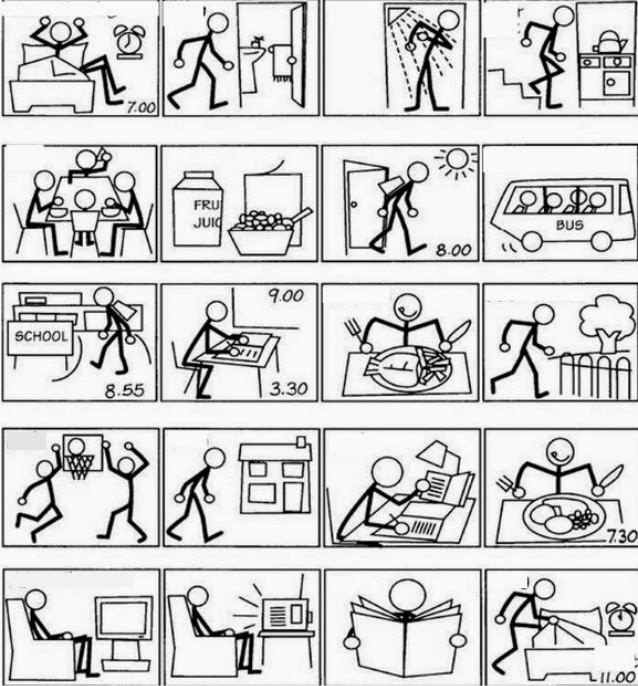
Esta lección es para ti si estás en segundo curso y estás aprendiendo a utilizar los tiempos del pretérito. Para contestar a la pregunta "¿Qué hizo ayer?" necesitas el pretérito perfecto simple (antiguamente llamado, erróneamente, pretérito indefinido).
This lesson is for you if you're in second year and you're learning to use the past tenses. To answer the question "What did he/she do yesterday?" you need the simple past tense (formerly incorrectly called the indefinite past tense).
El pretérito perfecto simple
Simple past
The simple past tense is used to talk about completed actions with no connection to the present, that is, at a specific and finished moment in the past. It is also used to make a value judgment about something that is finished in the past: 'it was good' (estuvo bien) or 'it was a good day' (fue un buen día).
Here are some examples of conjugation with regular verbs (levantarse, comer) and one irregular verb (hacer). To have the conjugations of other irregular verbs at hand, download the cheat sheet by clicking here.
| LEVANTARSE - To get up | COMER - To eat | HACER - To do, to make |
|---|---|---|
| Me levanté | Comí | Hice |
| Te levantaste | Comiste | Hiciste |
| Se levantó | Comió | Hizo |
| Nos levantamos | Comimos | Hicimos |
| Os levantasteis | Comisteis | Hicisteis |
| Se levantaron | Comieron | Hicieron |
Ya sabes que los fines de semana nuestra rutina cambia: trasnochamos más y madrugamos menos. Mira el vídeo de SGEL ELE para descubrir qué hizo Eva este fin de semana. Después de ver el vídeo, lee las preguntas e intenta responderlas de memoria. Vuelve a ver el vídeo para comprobar tus respuestas.
You already know that on weekends our routine changes: we stay up later and wake up later. Watch the SGEL ELE video to find out what Eva did this weekend. After watching the video, read the questions and try to answer them from memory. Watch the video again to check your answers.
Actividad en clase: ¿Qué hizo Eva ayer?
Class activity: What did Eva do yesterday?
- ¿Con quién salió Eva ayer?
- ¿Dónde cenaron?
- ¿Quién cocinó?
- ¿Qué cenaron?
- ¿Qué hicieron después de cenar?
- ¿Dónde fueron primero?
- ¿Dónde fueron luego?
- ¿Cómo volvió Eva a casa?
- ¿A qué hora dice Eva que llegó a casa?
- ¿A qué hora llegó realmente?
Son demasiadas preguntas y a Eva le fastidian, le parecen un interrogatorio. Dentro de unos años, cuando Eva sea madre, recordará cómo era su padre y comprenderá por qué su padre le hacía tantas preguntas. Observa que en esta frase estoy utilizando el pretérito imperfecto para hablar del pasado. Si ya has aprendido a utilizar el pretérito imperfecto, puedes descargar la actividad de extensión.
There are too many questions, and Eva finds them annoying; they feel like an interrogation. In a few years, when Eva becomes a mother, she will remember what her father was like and will understand why her father used to ask her so many questions. Notice that in this sentence, I am using the imperfect tense to talk about the past. If you have already learned to use the imperfect tense, you can download the extension activity.
Extensión: Cómo eran mis padres