2. Los viajes
4. El futuro del transporte
¿Has oído hablar de túneles de transporte? ¿Taxis voladores? ¿Turismo espacial? ¿Cómo será el transporte del futuro? En esta lección, vamos a trabajar con el futuro imperfecto para hacer pronósticos y hablar de un futuro imaginario, y con el condicional para expresar deseos, opiniones y plantear situaciones hipotéticas. Para entrar en materia, mira este vídeo de Expansión sobre el futuro del transporte.
Have you heard about transport tunnels? Flying taxis? Space tourism? What will transportation be like in the future? In this lesson, we’re going to work with the simple future to make predictions and talk about an imaginary future, and with the conditional tense to express wishes, opinions, and discuss hypothetical situations. To get started, watch this video from Expansión about the future of transportation.
El futuro perifrástico vs imperfecto
The near future vs the 'imperfect' future
In Spanish, when we speak about our plans for the future, we tend to use the near future. Because this structure is formed with the present tense of the verb ir (to go), it makes our resolution stronger, more tangible (e.g., El año que viene, voy a estudiar Ciencias Empresariales = Next year, I'm going to study Business Administration).
When speaking about a future more incertain or hypothetical, we prefer using the simple future, called the 'imperfect' future in Spanish. It is the tense for predictions and guesses (e.g., Cuando sea mayor, ganaré mucho dinero = When I'm older, I'll make a lot of money).
If you need to revise its forms, rewatch this video from Cursos Ele.
Trabajo grupal: Imagina
Group work: Imagine
En grupo, imaginad un medio de transporte futurístico: ¿Cómo será? ¿Qué prestaciones ofrecerá? ¿Para qué servirá? ¿Cómo se llamará? Sois un equipo de ingenieros. Escribid una propuesta con vuestro proyecto. Usad el futuro imperfecto para describir vuestro invento.
In groups, imagine a futuristic means of transportation:
What will it be like? What features will it offer? What will it be used for? What will it be called? You are a team of engineers. Write a proposal for your project. Use the simple future tense to describe your invention.
De Profe a Profe:
Para la puesta en común, mientras los alumnos leen en voy alta sus propuestas, escribe en la pizarra sus frases con futuro imperfecto. Esto te permitirá tener un banco de ejemplos en la pizarra, que vas a utilizar para demostrar lo fácil que es transformar los verbos del futuro al condicional.También será muy interesante ver cuál ha sido la preocupación principal de los equipos a la hora de inventar su medio de transporte. Puedes usar estas observaciones como punto de partida para introducir la segunda parte de la lección, enfocada en el condicional.
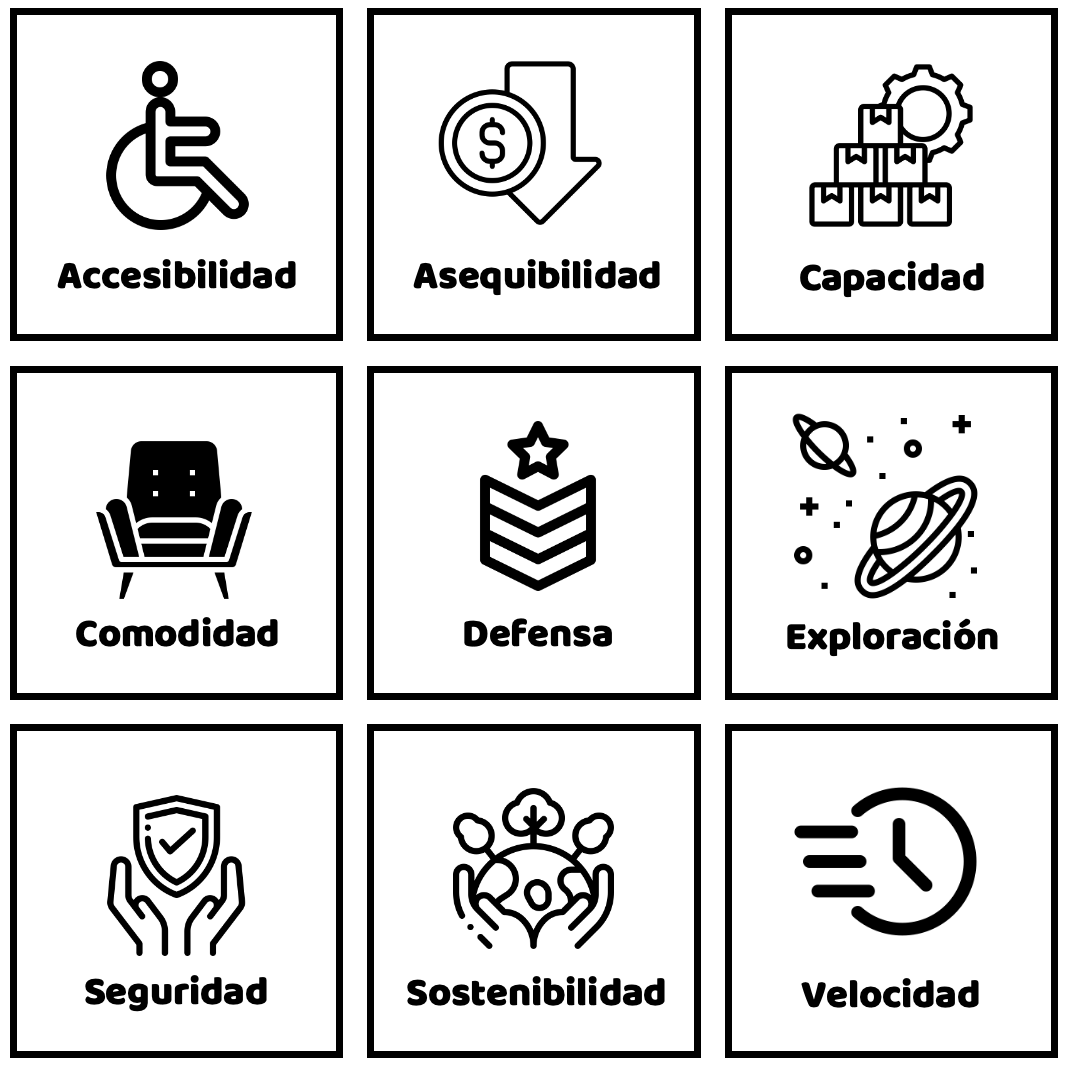
En todo el mundo, los gobiernos, a través de sus ministerios de transporte, invierten grandes cantidades de dinero en investigación para el desarrollo del transporte. En la imagen, puedes ver varios focos de atención. ¿Cuál debería ser su prioridad?
All around the world, governments, through their ministries of transportation, invest large amounts of money in research for the development of transport. In the image, you can see several areas of focus. What should be their priority?
Trabajo grupal: Debate y escribe
Group work: Debate and write
En grupo, pensad en estas cuestiones:
- ¿Cuál debería ser la máxima prioridad?
- ¿Cuál sería la última?
- ¿Cuáles serían tus tres prioridades principales?
- ¿En qué orden de importancia?
Después de sopesar los pros y contras, discutid vuestros puntos hasta llegar a un acuerdo. Escribid una lista de recomendaciones para el Ministerio de Transporte, utilizando el condicional (p.ej., se debería, tendrían que, podríamos...).
In groups, think about these questions:
- What should be the top priority?
- What would be the least important?
- What would your three top priorities be?
- In what order of importance?
After weighing the pros and cons, discuss your points until you reach an agreement. Write a list of recommendations for the Ministry of Transportation, using the conditional tense (e.g., we should, they would have to, we could...).
Futuro imperfecto vs Condicional
Future vs Conditional
Once you know how to conjugate a verb in the future tense, conjugating the same verb in the conditional tense is a piece of cake. You just need to change the endings. While the future tense loosely uses the endings of the simple past (é, ás, á, emos, éis, án), the conditional borrows its endings from the imperfect past (ía, ías, ía, íamos, íais, ían).
Reflect on the uses of the future and conditional tense by analyzing the examples.
|
Futuro
|
Condicional
|
|---|---|
|
Tendré que comprarme un escúter para moverme por la ciudad. I’ll have to buy myself a scooter to get around the city. |
Para llegar antes al colegio, tendría que comprarme un escúter.
To reach school earlier, I would have to buy mysekf a scooter.
|
|
Si vas a pie, ahorrarás energía y dinero.
If you go on foot, you will save energy and money.
|
Si fueras a pie, ahorrarías energía y dinero.
If you went on foot, you would save energy and money.
|
|
En el futuro, habrá motos voladoras.
In the future, there will be flying motorbikes.
|
La gente pensaba que en el futuro habría motos voladoras.
People used to think that in the future there would be flying motorbikes.
|
|
Me pregunto si podremos salvar nuestro planeta.
I wonder if we will be able to save our planet.
|
Me preguntaba si podríamos salvar nuestro planeta. I used to wonder if we would be able to save the planet. |
|
¿Iréis a México?
Will you go to Mexico?
|
¿Iríais a Marte?
Would you go to Mars?
|
|
Si ganan los ecologistas, cambiarán muchas leyes.
If the environmentalists win, they will change many laws.
|
Si ganasen los ecologistas, cambiarían muchas leyes. If the environmentalists won, they would change many laws. |