IB Guide (FAQ)
Nota: Contenido descargable en español al final de la página.
The official Language Ab Initio guide describes the course in detail, including its aims, content, assessment objectives and criteria. It places the course within the mission, vision, and structure of the Diploma Programme as a whole and establishes links to other areas such as the IB Learner Profile, Core Components and Approaches to Teaching and Learning (ATL).
Here, you will find a brief summary of the guide in the form of a FAQ, focusing on the most practical aspects from a student's perspective.
Spanish Ab Initio is one of the modern language acquisition courses offered in Group 2 of the Diploma Programme. It is only offered at Standard Level (SL), and is designed for beginner students "with no prior experience of the target language or those students with very limited previous exposure".
The guide remains vague about what constitutes a "very limited previous exposure" to the target language. It does, however, make a very clear and important statement in regard to students who are already able to understand and respond to spoken and written language on a range of common topics; they are "not to be placed in language ab initio, as this would not provide an appropriate academic challenge, nor is it fair for those students who are genuine beginners of the language".
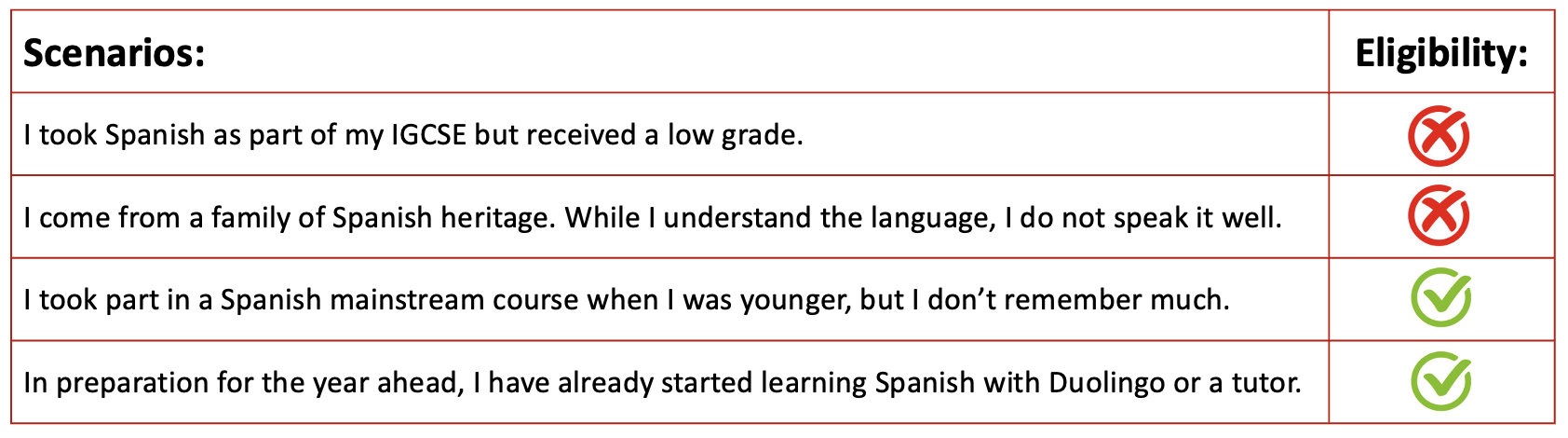
Without being exhaustive, the table below aims to apply the above guiding principle to a few common scenarios. Please note that this information comes from discussions with the IB Support Team but is not reflected in the guide. Ultimately, your school should review your case and decide whether you are eligible to enroll in the course. In doubt, the school should contact the IB to ensure that your admission does not violate ethical principles.
You will learn to communicate successfully in Spanish, both in familiar and unfamiliar contexts. The course aims to develop three linguistic skills:
Receptive skills: You will understand simple sentences as well as more complex ones, both in oral and written forms, pertaining to the five prescribed themes and associated topics. You will also grasp the meaning of straightforward authentic and adapted written and audio texts, along with related questions in Spanish.
Productive skills: You will convey information with reasonable accuracy, both in written and spoken form, employing a variety of basic vocabulary and grammatical structures. You will engage in oral communication and respond appropriately to the majority of questions related to the five prescribed themes and associated topics.
Interactive skills: You will understand and respond effectively to information and ideas encompassed by the five prescribed themes and related topics. You will participate in uncomplicated conversations, employing strategies to negotiate meaning and facilitate communication. Beyond linguistic skills, you should gain an intercultural understanding that broadens your awareness of the world and fosters respect for cultural diversity.
The syllabus is organised in five prescribed themes, each with four associated topics. Please note that there exist synergies among the 20 topics, and that your teacher may choose to address them in a different order than presented below.
1. Identities (Identidades):
- Personal attributes (Atributos personales)
- Personal relationships (Relaciones personales)
- Eating and drinking (Comida y bebida)
- Physical well-being (Bienestar físico)
2. Experiences (Experiencias):
- Daily routine (Rutina diaria)
- Leisure (Ocio)
- Holidays (Vacaciones)
- Festivals and celebrations (Festivales y celebraciones)
3. Human ingenuity (Ingenio humano):
- Transport (Transporte)
- Entertainment (Entretenimiento)
- Media (Medios de comunicación)
- Technology (Tecnología)
4. Social organization (Organización social):
- Neighborhood (Mi barrio)
- Education (Educación)
- The workplace (Lugar de trabajo)
- Social issues (Cuestiones sociales)
5. Sharing the planet (Cómo compartimos el planeta):
- Climate (Clima)
- Physical geography (Geografía física)
- Environment (Medio ambiente)
- Global issues (Cuestiones globales)
You will be evaluated on all skills (receptive, productive and interactive), and your cultural and conceptual understanding will also be taken into consideration.
You will sit four exams, each worth 25% of your final score.
Paper 1 (Writing) and Papers 2 (Reading and Listening) are externally set and marked by IB examiners.
The Individual Oral Assessment (IOA) is internally set and marked by your teacher, following strict instructions and criteria prescribed by the IB; a random selection of samples are sent to the IB for external moderation.
Detailed information about each assessment (structure, evaluation criteria, markbands), as well as strategies and practice papers, can be found in the relevant sections of this site. Click on the links for quick access.
The IB recommends 150 teaching hours for this subject. The guide, however, does not provide an estimate of how many hours of personal study should complement the learning done at school.
You will be expected to dedicate a significant amount of time to revision, research, and reflection to consolidate and expand upon the content covered inside the classroom. Although study time will vary for each individual, as a rule of thumb, you will likely need to invest as many hours studying at home as you spend in class at school.
No. Extended Essays are limited to HL subjects.